REX registered 0% duty into the EU, UK, Canada & Japan — see current status

Why source from Nepalकिन नेपाल

Duty-free apparel sourcing from Nepal — into the EU, UK and Japan

Manufacturing your knit garments in Nepal isn’t just competitive on price. For the EU, UK and Japan it lands your goods duty-free — a direct saving on every unit — and it’s a practical way to diversify your sourcing beyond the largest hubs.
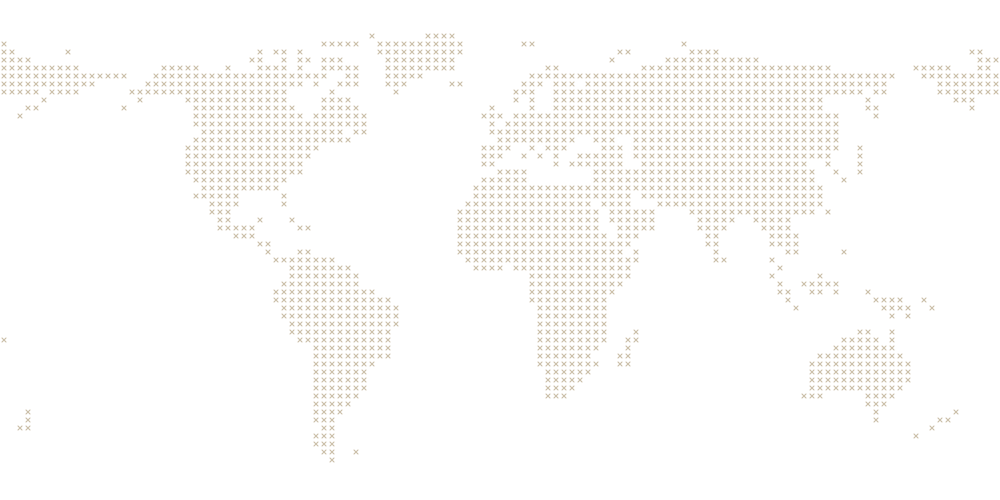
Where garments from Trishakti Apparel enter duty-free Threads run from Gaindakot, Nepal to the EU (including Germany, France and the Netherlands), the UK, Canada, Japan, China, India and Australia at 0% or conditional duty; the United States and the United Arab Emirates apply standard duty. 0% UK 0% EU 0% Germany 0% France 0% Netherlands 0% Canada Duty USA 0% Japan 0% China 0%* Korea 0%* India Duty UAE 0%* Australia Gaindakot
Cross-stitch map · Natural Earth data. 0%* = conditional on origin rules — see the market page.

Market by market

Nepal’s LDC graduation is scheduled for 24 November 2026. United Nations (source: Nepal – graduation status (scheduled 24 November 2026; 2026 extension request, CDP and ECOSOC), opens in a new tab) European Commission (source: The EU’s renewed GSP scheme: key updates for 2027 (Regulation (EU) 2026/1395; EBA for 2026 graduates at least until end-2029), opens in a new tab) +5 Current status →

01The duty advantage

Where does Nepal-made knitwear enter at 0% duty?

  • European Union — Everything But Arms (EBA): 0%. Cutting and sewing in Nepal confers origin, so imported fabric qualifies. Our REX registration puts the origin statement on your invoice.
  • United Kingdom — Developing Countries Trading Scheme (DCTS): 0%, with the same single-transformation rule for garments and a statement on origin under our REX registration.
  • Japan — GSP for least-developed countries: 0% on knit apparel made in Nepal, with a certificate of origin.
  • Canada — Least Developed Country Tariff (LDCT): 0% against 18% standard. Since 1 January 2025, apparel cut and sewn in an LDC qualifies whatever the fabric’s origin; we sign CBSA Form B255.
  • United States — not duty-free. The Nepal Trade Preference Program expired in December 2025, so standard US duty applies.

02The maths

How much duty does sourcing from Nepal save in Europe?

On a cotton knit t-shirt, an EU importer pays around 12% standard duty when sourcing from most countries — but 0% from Nepal under EBA. That is a direct landed-cost advantage before you’ve negotiated a single price, with the same 0% into the UK and Japan.

03

How does Nepal compare with other duty-free origins?

Bangladesh, Cambodia and other least-developed countries also enter the EU and UK at 0%, so if you already buy from them, duty is not the reason to move. What we add at our garment factory in Nepal is a 200-piece-per-style-and-colour minimum, dedicated capacity and a factory that answers within 24 hours.

04The window

How long does the 0% duty last?

Nepal’s graduation from least-developed-country status is scheduled for 24 November 2026. Nepal has asked the UN to defer it to 2029 and that decision is still pending; after graduation the EU and UK each allow a transition of about three years before LDC preferences end. We track the position and will tell you exactly what applies to your market and delivery dates. Our REX registration and duty status.

05Beyond duty

Why else do buyers choose Nepal?

  • Minimums from 200 pieces per style and colour (1,000 per order)
  • A workforce of around 80% women, local and permanent
  • Factory power from Nepal’s largely hydro-electric grid
  • English-speaking, owner-led communication within 24 hours

Margin calculator

What does 0% duty put back in your margin?

Example FOB prices are illustrative, not our quote. Duty is charged on customs value (usually CIF in the EU/UK, FOB in Canada and the US), so real savings are often slightly higher. Rates verified 2026-09-24; confirm your HS line with your customs broker.

Standard duty into European Union: 12% · from Nepal: 0%

You keep, per year

$7,680

Per piece
$0.38
Per order
$1,920
How importing into European Union works →

Where your garment is made

Between the Himalaya and the plains.

Map of Nepal: where Trishakti Apparel makes your garments Nepal’s Himalayan peaks along the north, including all eight 8,000-metre mountains, and its river systems — Mahakali, Karnali, Gandaki (Narayani), Bagmati and Koshi — flowing south towards the Ganga and the Bay of Bengal. Gaindakot sits beside Devghat, where the Kali Gandaki and Trishuli form the Narayani. Roads lead to the Birgunj dry port for sea freight and to Kathmandu airport for air freight. Everest 8,849 mKangchenjunga 8,586 mMakalu 8,485 mCho Oyu 8,188 mDhaulagiri 8,167 mManaslu 8,163 mAnnapurna 8,091 m NarayaniBagmatiKoshiKali GandakiKarnaliArunTrishuliSun KoshiMahakaliBheri To Kolkata & Vizag ports → Bay of Bengal ✈ air INDIA CHINA (TIBET)

← Swipe the map · tap any mountain or pin →

Gaida Chowk · ≈200 m

Gaindakot — our factory

Our cut-and-sew floor: 150+ machines and a team that is 80% women. Near Nepal’s East–West Highway, minutes from Devghat, where the Kali Gandaki and the Trishuli become the Narayani.

Capital · Tribhuvan International Airport

Kathmandu

Our air-freight gateway (FCA Kathmandu), about five hours by road. Samples leave from here by express courier and usually arrive in 3–7 days; urgent orders fly from here too.

Start of the sea route

Birgunj dry port

Nepal’s main dry port, rail-linked to Kolkata/Haldia and Visakhapatnam. Our sea cargo crosses India here — heading, like every river on this map, for the Bay of Bengal.

Lake city below the Annapurnas

Pokhara

Nepal’s lakeside city beneath Machhapuchhre and the Annapurna range — about half a day’s drive from our factory. The Seti Gandaki runs through it.

Birthplace of the Buddha

Lumbini

A UNESCO World Heritage Site in the plains west of us, near the Bhairahawa–Sunauli crossing into India.

8,849 m · world’s highest

EverestSagarmatha (सगरमाथा), “forehead of the sky”

The highest point on Earth, on Nepal’s border with China. Its Nepali name means “forehead of the sky”; the Sherpa people call it Chomolungma.

Where
Solukhumbu · Sagarmatha National Park (UNESCO)
First ascent
29 May 1953 — Tenzing Norgay Sherpa and Edmund Hillary

8,586 m · world’s 3rd highest

Kangchenjunga“Five treasures of the snow”

The world’s third-highest mountain, in Nepal’s far east. Its five summits are said to hold five treasures — gold, silver, gems, grain and holy books.

Where
Taplejung · on the Nepal–India (Sikkim) border
First ascent
25 May 1955 — Joe Brown and George Band, who stopped just short of the top out of respect for its sanctity

8,516 m · world’s 4th highest

Lhotse“South peak” (of Everest)

The world’s fourth-highest mountain, standing shoulder to shoulder with Everest — the two share much of the same climbing route.

Where
Solukhumbu · joined to Everest by the South Col
First ascent
18 May 1956 — Ernst Reiss and Fritz Luchsinger (Swiss expedition)

8,485 m · world’s 5th highest

Makalu

The world’s fifth-highest mountain, a striking four-sided pyramid rising above the Arun valley — a river that flows on to join the Koshi.

Where
Sankhuwasabha · Makalu Barun National Park
First ascent
15 May 1955 — Lionel Terray and Jean Couzy (French expedition)

8,188 m · world’s 6th highest

Cho Oyu“Turquoise goddess”

The world’s sixth-highest mountain, west of Everest, beside the ancient Nangpa La trade route between Nepal and Tibet.

Where
Solukhumbu · near the Nangpa La pass to Tibet
First ascent
19 October 1954 — Herbert Tichy, Joseph Jöchler and Pasang Dawa Lama

8,167 m · world’s 7th highest

Dhaulagiri I“White mountain”

The world’s seventh-highest mountain. The Kali Gandaki runs between it and Annapurna through one of the deepest gorges on Earth — then on past our factory to Devghat.

Where
Myagdi · west of the Kali Gandaki gorge
First ascent
13 May 1960 — Swiss–Austrian expedition (Kurt Diemberger and team, with Nawang Dorje and Nima Dorje Sherpa)

8,163 m · world’s 8th highest

Manaslu“Mountain of the spirit”

The world’s eighth-highest mountain, in Gorkha district — the homeland of the Gorkha kings who unified Nepal.

Where
Gorkha · Manaslu Conservation Area
First ascent
9 May 1956 — Toshio Imanishi and Gyalzen Norbu Sherpa (Japanese expedition)

8,091 m · world’s 10th highest

Annapurna I“Goddess of the harvests”

The first 8,000-metre mountain ever climbed. Its massif towers over Pokhara, and its snow feeds the Kali Gandaki and Seti rivers.

Where
Myagdi / Kaski · Annapurna Conservation Area
First ascent
3 June 1950 — Maurice Herzog and Louis Lachenal (French expedition)

7,422 m

Ganesh Himal (Ganesh I)Named after Lord Ganesh

A cluster of peaks named for Ganesh, remover of obstacles — clearly visible from Kathmandu on a clear morning.

Where
Gorkha / Dhading / Rasuwa · on the Tibet border
First ascent
1955 — Raymond Lambert, Eric Gauchat and Claude Kogan

7,234 m

Langtang Lirung

The high point of the Langtang valley, the closest great Himalayan range to Kathmandu. Its meltwater feeds the Trishuli — which meets the Kali Gandaki at Devghat, beside our factory.

Where
Rasuwa · Langtang National Park

7,134 m

Gauri ShankarGauri and Shankar — Parvati and Shiva

A mountain sacred to Hindus as the divine couple Parvati and Shiva, and to Sherpas as Tseringma, one of five sisters of long life.

Where
Dolakha · Rolwaling valley
First ascent
8 May 1979 — John Roskelley and Dorje Sherpa

7,132 m

Api

The highest peak of Nepal’s far west, rising above the upper Mahakali valley — remote, rarely visited and beautiful.

Where
Darchula · Api Nampa Conservation Area, far-west Nepal

7,031 m

Saipal

A lone giant of the far west, standing between the Seti and Karnali river systems.

Where
Bajhang / Humla · far-west Nepal

6,993 m

Machhapuchhre“Fish tail”

Named for its twin-pointed summit shaped like a fish’s tail. Held sacred to Shiva, it is closed to climbers — its summit has never officially been stood upon.

Where
Kaski · above Pokhara
First ascent
None — closed to climbers; a 1957 team turned back about 50 m below the summit, out of respect

6,812 m

Ama Dablam“Mother’s necklace”

Often called the most beautiful mountain in the world — its long ridges are the mother’s arms, and its hanging glacier the dablam, a pendant worn by Sherpa women.

Where
Solukhumbu · Khumbu valley
First ascent
13 March 1961 — Mike Gill, Barry Bishop, Mike Ward and Wally Romanes

Tap a pin or any mountain. Outline: Survey Department of Nepal. Rivers © OpenStreetMap contributors. Peaks: all eight of Nepal’s 8,000-metre mountains.

Nepal, beyond the tariff sheet

  1. Dhaka

    Hand-loomed geometric cloth, worn in the dhaka topi — Nepal’s signature textile.

  2. Allo

    Himalayan giant nettle, hand-spun into one of the world’s oldest sustainable fibres.

  3. Pashmina

    The fine undercoat of high-altitude goats, spun and woven in the Kathmandu valley.

  4. Knitwear

    The next chapter: modern cut-and-sew knit basics, made to export standard in Gaindakot.

How REX gets you 0% dutyNepal’s flag, history & culture

Questions

Straight answers.

Is clothing made in Nepal duty-free in the EU?
Yes. Under the EU’s Everything But Arms scheme, garments cut and sewn in Nepal enter at 0% while Nepal is a least-developed country, even with imported fabric. As a REX-registered exporter we put the origin statement on every invoice.
Is it duty-free into the UK?
Yes. Under the UK Developing Countries Trading Scheme (DCTS), Nepal-made garments enter at 0%, with the origin statement supplied under our REX registration.
What about Canada?
Yes — Canada’s Least Developed Country Tariff is 0% against 18% standard duty on knit tops. Since 1 January 2025, apparel cut and sewn in an LDC qualifies whatever the fabric’s origin, so our imported fabric is fine. We sign CBSA Form B255 as the exporter’s certificate of origin.
Is Nepal duty-free into the USA?
No. The Nepal Trade Preference Program expired in December 2025, so standard US duty applies to garments from Nepal.
What happens when Nepal graduates from LDC status?
Graduation is scheduled for 24 November 2026; Nepal has requested a deferral to 2029 and the UN decision is pending. After graduation the EU and UK each allow a transition of about three years before LDC preferences end.

Sources & last verified

Page facts checked

We link every trade claim to the body that publishes it — official sources first. Rules change; if you spot something out of date, tell us.

  1. 01 Preferential Rules of Origin – guide to claiming preferential rates under non-FTA arrangements (LDC rule, s153NA; 25% cap on non-LDC developing-country materials) Australian Border Force · official · checked 24 Sept 2026
  2. 02 Working tariff – Schedule 3, Section XI, Chapter 61 Australian Border Force · official · checked 24 Sept 2026
  3. 03 Customs Notice 24-41: Canada’s unilateral tariff preference programs for imports from developing countries Canada Border Services Agency · official · checked 24 Sept 2026
  4. 04 Memorandum D11-4-4: Rules of origin respecting the GPT and LDCT (Form B255 for textiles and apparel) Canada Border Services Agency · official · checked 24 Sept 2026
  5. 05 Customs Tariff 2026 – Chapter 61 (MFN 18%; LDCT Free) Canada Border Services Agency · official · checked 24 Sept 2026
  6. 06 Effective rates of customs duty from 1 Nov 2025, superseding 50/2017-Customs (no Chapter 61 entry) CBIC – Notification 45/2025-Customs (24 Oct 2025) · official · checked 25 Sept 2026
  7. 07 IGST from 22 Sep 2025: Chapter 61 garments 5% up to Rs 2,500 sale value per piece, 18% above CBIC – Notification 9/2025-Integrated Tax (Rate) · official · checked 25 Sept 2026
  8. 08 Customs Tariff of India – Chapter 61: 6109 10 00 "20% or Rs. 45 per piece, whichever is higher"; 6105 10 20% or Rs 83; 6110 20 00 20% or Rs 85 Central Board of Indirect Taxes and Customs (CBIC), India · official · checked 25 Sept 2026
  9. 09 Canada’s unilateral tariff preference programs for imports from developing countries (LDCT renewed to 2034; three-year post-graduation transition) Department of Finance Canada · official · checked 24 Sept 2026
  10. 10 Services Guide 2025 (customs declaration: invoice, packing list, certificate of origin; business registration with trade licence) Dubai Customs · official · checked 25 Sept 2026
  11. 11 FAQ: customs duty is 5% of the CIF value (GCC Common Customs Law) Dubai Customs · official · checked 25 Sept 2026
  12. 12 Commission Delegated Regulation (EU) 2015/2446 – Annex 22-03 (GSP product-specific rules, separate LDC column) EUR-Lex (Official Journal of the EU) · official · checked 24 Sept 2026
  13. 13 Commission Regulation (EU) No 1063/2010 – GSP rules of origin reform applying from 1 January 2011 (single transformation for LDC garments) EUR-Lex (Official Journal of the EU) · official · checked 24 Sept 2026
  14. 14 The EU’s renewed GSP scheme: key updates for 2027 (Regulation (EU) 2026/1395; EBA for 2026 graduates at least until end-2029) European Commission – Access2Markets · official · checked 24 Sept 2026
  15. 15 A guide for users on GSP rules of origin (REX, statements on origin, EUR 6,000 threshold) European Commission – DG TAXUD · official · checked 24 Sept 2026
  16. 16 TARIC measures for CN 6109 10 00 (cotton knitted T-shirts), origin Nepal European Commission – TARIC · official · checked 24 Sept 2026
  17. 17 Order No. 231, as amended by Order No. 273 (2024): rules of origin for goods from least developed countries (change of heading or 40% value content; Chinese materials count as originating; direct transport; certificate) General Administration of Customs of China (GACC) · official · checked 25 Sept 2026
  18. 18 Online tariff query, 2026: 6109100000, 6105100010/90 and 6110200010/90 — MFN 6%, import VAT 13% General Administration of Customs of China (GACC) · official · checked 25 Sept 2026
  19. 19 Preference tier graduation: Bhutan (three-year DCTS transition after UN LDC graduation) GOV.UK – Department for Business and Trade · official · checked 24 Sept 2026
  20. 20 Update: improved rules of origin under the DCTS are now in effect (1 January 2026) GOV.UK – Department for Business and Trade · official · checked 24 Sept 2026
  21. 21 How to claim preferences under the Developing Countries Trading Scheme (DCTS) – Form A or origin declaration GOV.UK – HMRC · official · checked 24 Sept 2026
  22. 22 Customs Tariff Law of the PRC (in force 1 December 2024): customs value includes transport and insurance to the place of import Government of China (gov.cn) · official · checked 25 Sept 2026
  23. 23 SAFTA rules of origin: change of heading and non-originating materials ≤ 60% of FOB, 70% for LDCs; regional cumulation Government of India – Notification 75/2006-Customs (N.T.) (third-party copy) · official · checked 25 Sept 2026
  24. 24 Simplification of preferential rules of origin under GSP for knitted apparel (HS Chapter 61), from 1 April 2015 Japan Customs · official · checked 24 Sept 2026
  25. 25 Outline of Japan’s GSP (FAQ 1501) – duty-free, quota-free treatment for LDCs Japan Customs · official · checked 24 Sept 2026
  26. 26 Japan’s Tariff Schedule as of 8 August 2026 – Chapter 61 Japan Customs · official · checked 24 Sept 2026
  27. 27 General Preferential Tariff, GPT Plus and Least Developed Country Tariff Rules of Origin Regulations (SOR/2023-210) Justice Laws Website, Government of Canada · official · checked 24 Sept 2026
  28. 28 Regulations on Providing Preferential Tariff Treatment to Least Developed Countries — English translation (2021 version; Article 5 rules of origin unchanged since) Korea Legislation Research Institute (official English translation) · official · checked 27 Sept 2026
  29. 29 LDC preferential tariff regulations, Appendix 1 (amended 28 Feb 2025): eligible countries; Note 1 — preferences for Nepal, Laos and Bangladesh apply to goods declared for import by 23 November 2029 Korea Ministry of Government Legislation – National Law Information Center · official · checked 27 Sept 2026
  30. 30 Regulations on Providing Preferential Tariff Treatment to Least Developed Countries (최빈개발도상국에 대한 특혜관세 공여 규정), Presidential Decree No. 35947, in force 2 January 2026: Art. 2 (three years after graduation), Art. 5 (rules of origin: non-originating materials ≤ 60% of FOB price, Korean materials excluded; certificate of origin) Korea Ministry of Government Legislation – National Law Information Center · official · checked 27 Sept 2026
  31. 31 Customs Act (관세법, Act No. 21858, in force 11 Aug 2026): Art. 50 and its tariff schedule (basic rate 13% on 6105.10, 6109.10 and 6110.20); Art. 30 (customs value includes freight and insurance to the Korean port); Art. 76(3) (LDC preferences continue for a set period after graduation) Korea Ministry of Government Legislation – National Law Information Center · official · checked 27 Sept 2026
  32. 32 Value-Added Tax Act (부가가치세법), Art. 29(2) and 30: import VAT of 10% on customs value plus duty (and any excise taxes) Korea Ministry of Government Legislation – National Law Information Center · official · checked 27 Sept 2026
  33. 33 LDC preferential tariff regulations, Appendix 2 (amended 31 Dec 2024): goods and preferential rates — every Chapter 61 and 62 line at 0%, including 6109.10, 6105.10 and 6110.20 (spreadsheet) Korea Ministry of Government Legislation – National Law Information Center · official · checked 27 Sept 2026
  34. 34 Union Budget 2026-27, customs changes: "Chapter 57-65: No Change"; Social Welfare Surcharge defined Ministry of Finance, India – Tax Research Unit · official · checked 25 Sept 2026
  35. 35 Notice of actions in Section 301 investigations of 60 economies related to forced labour import prohibitions (effective 24 July 2026) Office of the U.S. Trade Representative · official · checked 24 Sept 2026
  36. 36 VAT Law (in force 1 January 2026): import VAT on customs value plus duty State Taxation Administration of China · official · checked 25 Sept 2026
  37. 37 Treaty of Trade between Nepal and India, with Protocol (Article V rules of origin) Trade and Export Promotion Centre (TEPC), Government of Nepal · official · checked 24 Sept 2026
  38. 38 Trade agreements – Treaty of Trade with the Republic of India Trade and Export Promotion Centre (TEPC), Government of Nepal · official · checked 24 Sept 2026
  39. 39 Uyghur Forced Labor Prevention Act (UFLPA) U.S. Customs and Border Protection · official · checked 24 Sept 2026
  40. 40 Nepal Country Commercial Guide – Hydropower, water resources and renewable energy U.S. International Trade Administration (trade.gov) · official · checked 24 Sept 2026
  41. 41 Harmonized Tariff Schedule – 6109.10.00 (16.5%), 6105.10.00 (19.7%), 6110.20.20 (16.5%) U.S. International Trade Commission · official · checked 24 Sept 2026
  42. 42 Final agreement text, incl. UAE tariff schedule (Annex 2B): 6105.10, 6109.10, 6110.20 base rate 5%, category A (0% from day 1) UAE Ministry of Economy – UAE–India CEPA · official · checked 25 Sept 2026
  43. 43 Comprehensive Economic Partnership Agreements (partner list; Nepal and Bangladesh not listed) UAE Ministry of Foreign Trade · official · checked 25 Sept 2026
  44. 44 GCC free trade agreements (China listed as under negotiation) UAE Ministry of Foreign Trade · official · checked 25 Sept 2026
  45. 45 Tariff schedule of the UAE: 6105.10, 6109.10, 6110.20 base rate 5%, category E(0), duty-free on entry into force UAE–Vietnam CEPA, Appendix 2A-A (published by WTO Center Vietnam) · official · checked 25 Sept 2026
  46. 46 Commodity 6109100010 – T-shirts of cotton (third-country duty and DCTS rates) UK Integrated Online Tariff · official · checked 24 Sept 2026
  47. 47 Nepal – graduation status (scheduled 24 November 2026; 2026 extension request, CDP and ECOSOC) United Nations – LDC Portal · official · checked 24 Sept 2026
  48. 48 List of preferential trade arrangements (no UAE or other GCC scheme for developing or least developed countries) World Trade Organization – PTA database · official · checked 25 Sept 2026
  49. 49 Nepal – history (never under colonial rule) Encyclopaedia Britannica · checked 24 Sept 2026
  50. 50 Himalayas – the world’s highest peaks Encyclopaedia Britannica · checked 24 Sept 2026
  51. 51 Gurkha Encyclopaedia Britannica · checked 24 Sept 2026
  52. 52 Nepal will seek delayed LDC graduation citing economic constraints (16 May 2026) The Kathmandu Post · checked 24 Sept 2026
  53. 53 LDC graduation extension: ECOSOC recommends UNGA to take decision on Bangladesh, Nepal (July 2026) UNB (United News of Bangladesh) · checked 24 Sept 2026

Namaste — let’s talk

Tell us what you want to make.

Send a tech pack, a photo or just an idea. You’ll hear back from the people who run the floor — usually within 24 hours, Nepal time.

No WhatsApp and rather not email? Request a call-back and we’ll phone you.

Request a quote WhatsApp