Fabric · How to
GSM explained: what 180, 200 and 240 GSM mean for t-shirts and polos
GSM is the number that most affects how your garment feels, drapes and costs. Here’s what GSM means, the weight bands for t-shirts and polos, how to measure and specify it with a tolerance, what it does to cost and freight, and the mistakes buyers make.
When a factory asks what GSM you want, they’re asking how heavy your fabric should be, and it’s one of the biggest decisions for how your garment feels, how it drapes, what it costs and what it costs to ship. This guide covers what the number means, sensible weights for t-shirts and polos, and how to write GSM into a spec so the bulk matches the sample.
What does GSM mean for t-shirt fabric?
GSM stands for grams per square metre: the weight of one square metre of the finished fabric. Lower GSM is lighter, thinner and more breathable; higher GSM is heavier, more opaque and more structured. It isn’t “better or worse”, it’s fit for purpose.
Three things GSM is not:
- Not the garment’s weight. A 180 gsm tee weighs about 150–190 g depending on size, because a tee uses roughly one square metre of fabric or less.
- Not the same unit as “oz”. US specs often quote ounces per square yard. Multiply by about 33.9 to get GSM: a “5.3 oz” fabric is roughly 180 gsm, a “6 oz” fabric about 203 gsm.
- Not a measure of quality. Two “180 gsm, 100% cotton” tees can feel completely different, because the yarn (combed ring-spun or carded open-end) matters as much as the weight. The yarn guide explains why.
What do 180, 200, 220 and 240 GSM mean?
Each number is the fabric’s weight in grams per square metre. In cotton single jersey, the usual t-shirt fabric, they feel like this:
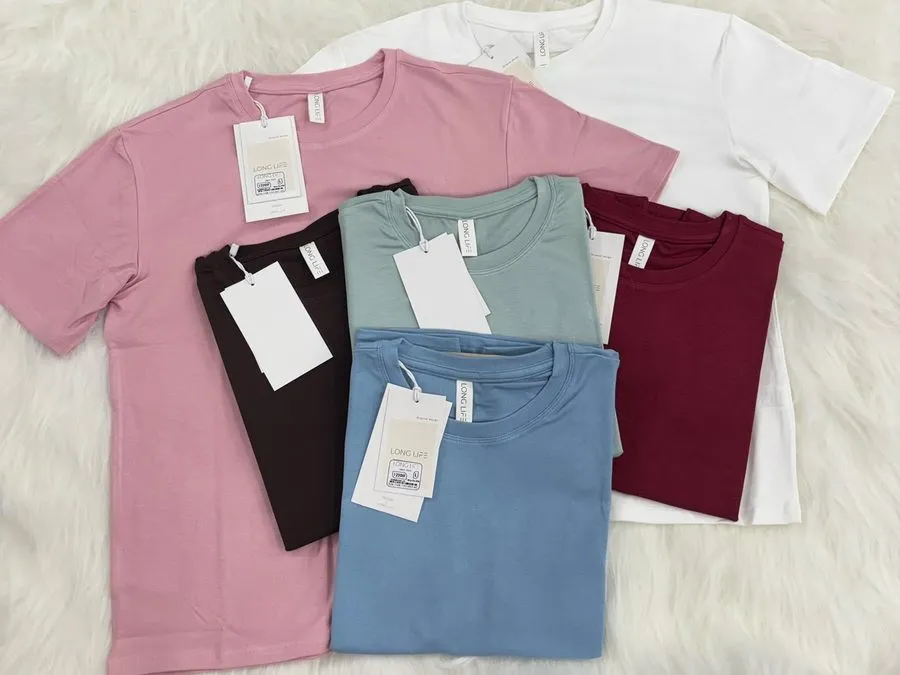
- 180 GSM: the everyday standard. Soft and breathable; the default for basics and merch.
- 200 GSM: a solid retail weight, a little thicker and more opaque, at the lower edge of heavyweight. A good weight for a brand’s core tee.
- 220 GSM: heavyweight. Noticeable body, and less see-through in white.
- 240 GSM: a structured heavyweight, common for boxy and oversized fits.
- 260 GSM and up: ultra-heavy streetwear weight. Warm, and best on a pattern designed for it.
There is no single best GSM: 180–200 GSM suits most everyday t-shirts, and 240 GSM or more suits oversized streetwear.
What GSM should a t-shirt or polo be?
T-shirts typically run from 140 to 300 gsm: 140–160 gsm is lightweight, 160–180 gsm standard, 180–200 gsm a safe default for a brand’s core tee, 200–240 gsm heavyweight and 240–300 gsm ultra-heavy streetwear. Piqué polos usually sit at 180–240 gsm. These are typical market ranges, not fixed standards:
| Garment | Typical GSM | Feel and use |
|---|---|---|
| Lightweight tee | 140–160 | Thin and breathable: promo, events, hot climates, layering |
| Standard tee | 160–180 | The catalogue workhorse for basics and merch |
| Solid retail tee | 180–200 | More substance and opacity; a safe default for a brand’s core tee |
| Heavyweight tee | 200–240 | Structured drape, premium basics, boxy fits |
| Ultra-heavy tee | 240–300 | Oversized streetwear |
| Piqué polo | 180–240 | 200–220 is the uniform sweet spot; 220+ feels premium |
Construction changes the picture. For the same yarn, interlock and piqué come out heavier than single jersey, which is why polos sit higher in the table. Knit constructions explained.
What determines the GSM of a fabric?
A mill reaches a given GSM through two levers: the yarn count (how thick each yarn is) and how tightly the fabric is knitted. Coarser yarn gives a heavier fabric at the same knit density. As a rough guide for cotton single jersey, and mills vary:
| Yarn count (Ne) | Typical single jersey weight |
|---|---|
| 40s/1 (fine) | about 120–140 gsm |
| 30s/1 | about 140–160 gsm |
| 24s–26s/1 | about 160–180 gsm |
| 20s/1 | about 180–210 gsm |
| 16s/1 (coarse) | about 220–250 gsm |
The practical point: hitting a target GSM with a coarser yarn knitted loosely is not the same as reaching it with the right yarn at the right density. Loose knitting gives an open, less stable fabric that twists and shrinks more. If a supplier hits your GSM at an unusually low price, ask for the yarn count and the fabric’s shrinkage and spirality results.
How should I write GSM into my spec?
State the construction, composition, yarn count and finished weight with a tolerance (±5% is common), say where the weight is measured, and tie it to a shrinkage limit, so the bulk matches the sample. A good fabric line leaves nothing to interpretation. For example:
Single jersey, 100% combed ring-spun cotton, 30s/1, finished weight 160 gsm ±5%, compacted, shrinkage within 5% in length and width after three washes.
- State a tolerance. ±5% is common: a 180 gsm spec then accepts 171–189 gsm.
- Say where it is measured. “Finished” means after dyeing, finishing and compacting, before cutting. Fabric absorbs moisture, so labs condition samples before weighing; ask for the mill’s test report per lot.
- Tie it to shrinkage. Cotton that shrinks gets heavier per square metre, so GSM and shrinkage limits belong in the same spec. The shrinkage guide.
- Re-approve if the weight changes. Moving from 180 to 220 gsm after the fit sample changes drape and sometimes shrinkage, so the next sample should be approved again.
How does GSM affect cost, freight and printing?
Heavier fabric usually costs more to make and to ship. In our published example, moving a 180 gsm tee to 240 gsm adds about a third to the fabric line and roughly 40% to the weight of the same carton count, while heavier, tighter-knit fabric gives a flatter, more stable surface for printing.
Cost. Fabric is the biggest line on a knit costing sheet, and it scales with weight. On our published example of a 180 gsm combed-cotton tee, the fabric line is 0.22 kg at $6.20 per kg, about $1.36. The same tee at 240 gsm needs about 0.29 kg, roughly $1.82 at the same fabric price: a third more on the fabric line, before any change in yarn. The full costing sheet.
Freight. Air freight is charged by weight (or volume, whichever is greater), and garments pack densely, so heavier fabric usually means a higher bill. A heavyweight 240 gsm tee runs about 225–260 g against 150–190 g for a 180 gsm tee, so the same carton count weighs roughly 40% more.
Print and opacity. Heavier, tighter-knit fabric gives a flatter, more stable surface for screen printing and embroidery, and light fabrics below about 160 gsm can look slightly see-through, especially in white. Very heavy fabric is warm, which matters in hot markets.
Which GSM should I choose for my t-shirts or polos?
Choose by use. Promo and event tees work at 140–160 gsm, retail basics at 160–200 gsm, premium basics at 200–220 gsm, and streetwear and oversized fits at 240–300 gsm, with the block designed for the weight. For uniform polos, 200–220 gsm piqué is the sweet spot.
- Promo and event tees: 140–160 gsm, cotton or CVC, where price per piece matters most.
- Retail basics: 160–180 gsm for value lines; 180–200 gsm for a brand’s core tee.
- Premium basics: 200–220 gsm in combed ring-spun, compacted cotton.
- Streetwear and oversized: 240–300 gsm, with the block designed for the weight.
- Uniform polos: 200–220 gsm piqué, often CVC for wash durability.
What GSM mistakes cost buyers money?
Three are common: comparing quotes on adjectives such as “heavyweight” instead of a stated GSM, yarn and composition; leaving the spec without a tolerance or measuring point, so an underweight bulk can’t simply be rejected; and judging fabric weight from a photo rather than feeling it in the hand.
- Comparing quotes on adjectives. “Heavyweight” and “premium” mean different things to different suppliers. Compare at the same GSM, yarn and composition.
- No tolerance, no measuring point. Without them, a 165 gsm bulk against a 180 gsm spec becomes an argument instead of a rejection.
- Judging weight from a photo. Feel the fabric. Weight, yarn and finish only make sense in the hand.
We cut and sew t-shirts and polos in Gaindakot, Nepal, from fabric knitted to your spec by established mills. You choose: our regular mills, OEKO-TEX-certified fabric, or a mill you nominate, and we confirm the mill and its country before you order. Our sample kit includes a fabric swatch card marked with each weight, or send us your target GSM and we’ll quote against it.
Frequently asked
Is 200 GSM good for a t-shirt?
What is the best GSM for a t-shirt?
Should I choose 180 gsm or 240 gsm for my t-shirts?
What GSM is best for oversized t-shirts?
What GSM is a heavyweight t-shirt?
Does GSM change after washing?
How do I check the GSM of garments I receive?
How much does a t-shirt weigh?
How much does a polo shirt weigh?
About the author
Santosh Rijal runs Trishakti Apparel, the export knitwear factory his family built on three decades in Nepal’s fashion trade. He writes about sourcing, duty and production from the factory floor in Gaindakot.
LinkedIn ↗