Quality · How to
How much do cotton t-shirts shrink? Shrinkage, compacting, and the spec that prevents it
Why cotton knits shrink, what compacting and other mill finishing do, how shrinkage and spirality are tested (ISO 6330, ISO 5077, AATCC TM135), the tolerances buyers typically write, how pattern allowances work, and what to do when bulk fabric fails.
Shrinkage looks like a defect, but it is mostly physics. Yarn is spun under tension, knitted under tension and pulled lengthwise through dyeing and drying. The fabric stores that stretch, and the first hot wash and tumble dry release it. The job is to make that relaxation happen at the mill rather than in your customer’s machine, then to write down, in numbers, how much is left.
Why do cotton knits shrink?
Cotton knits shrink because three effects add up: relaxation of loops that were stretched lengthwise from knitting to drying; cotton fibres swelling when wet and settling as they dry, especially in a hot tumble dryer; and residual shrinkage, the part of that relaxation the mill’s finishing has not removed. That residual figure is what your spec controls.
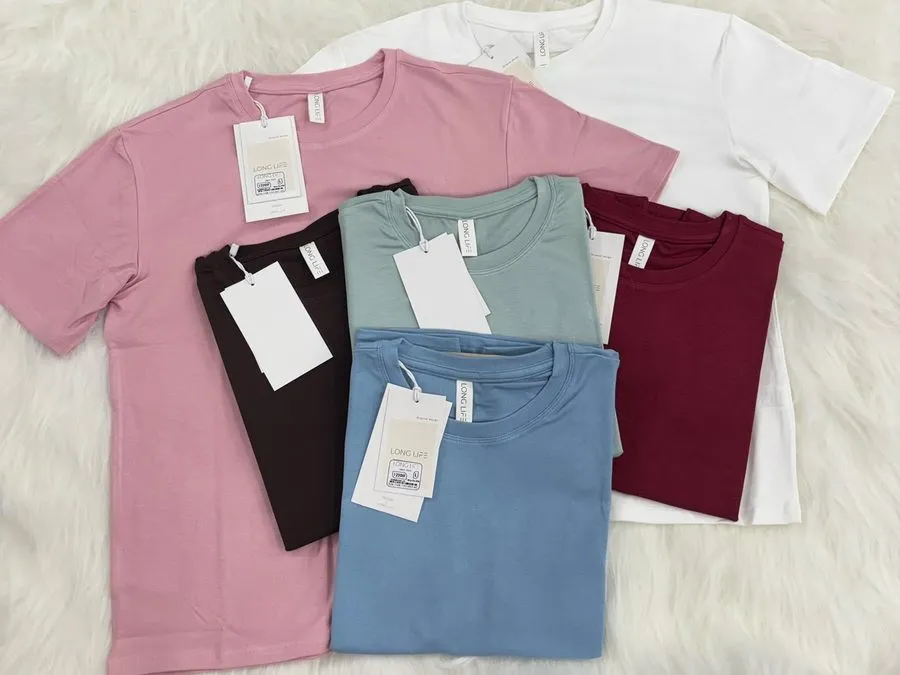
- Relaxation. A knit is a chain of loops. Every step from knitting to drying tends to stretch those loops in the length direction and narrow the fabric. Water and heat let them recover, so the fabric gets shorter and sometimes wider.
- Fibre swelling. Cotton swells when wet. As it dries, especially tumbling in a hot dryer, the structure settles into a more compact state.
- Residual shrinkage. Whatever relaxation the mill’s finishing has not removed stays in the fabric. That residual figure is the number on a test report, and the number your spec controls.
A loosely knitted fabric has more room to move, so it usually shrinks and twists more than a tight one of the same weight. How GSM, yarn count and knit density interact.
Single jersey adds a second problem: spirality, or twist. The yarn’s own twist and the circular knitting structure make the wales lean, so after washing the side seams walk towards the front. It is controlled by yarn and knitting choices and by finishing, and it needs its own limit in the spec. Why single jersey twists and interlock doesn’t.
Where is shrinkage controlled, and what does finishing do?
Shrinkage control is fabric finishing, and it happens at the fabric mill, not at the sewing factory. On cotton-rich knits, compacting pushes the loops together lengthwise so much of the shrinkage is spent before cutting. Relaxation drying, compressive shrinking (sanforising) for wovens and heat-setting for synthetics are the other main processes:
| Process | Used on | What it does |
|---|---|---|
| Relaxation drying | Knits | Dries the fabric with little tension so the loops can settle before finishing |
| Compacting | Cotton-rich knits, tubular or open-width | Feeds steamed fabric into a compacting zone with overfeed, pushing the loops together lengthwise so much of the shrinkage is spent before cutting |
| Compressive shrinking (sanforising) | Wovens | The woven equivalent: mechanically compresses the damp fabric lengthwise, then dries it in that state |
| Heat-setting | Polyester and other synthetics, and elastane blends | Stabilises the fibres at a temperature above normal washing, so they hold their dimensions |
Compacted fabric is a little denser, so finished GSM belongs in the same conversation. Ask your supplier which finishing route the fabric takes, and for the mill’s test report for each lot.
How is fabric shrinkage tested?
Shrinkage is tested by washing, drying and measuring fabric or garments to a named method, such as ISO 5077 with ISO 6330 procedures, or AATCC TM135 and TM150. Test standards describe how to wash, dry and measure. They do not set pass or fail limits; those come from your spec. The ones you are most likely to meet:
| Standard | What it covers |
|---|---|
| ISO 6330 | Domestic washing and drying procedures for textile testing: front-loading (Type A), top-loading agitator (Type B) and pulsator (Type C) machines, and six drying procedures including line dry, flat dry and tumble dry |
| ISO 5077 | Determining the dimensional change of fabrics, garments or other textile articles after specified washing and drying procedures |
| AATCC TM135 | Dimensional change of fabrics after home laundering, in length and width, with a choice of wash temperatures, agitation cycles and drying procedures |
| AATCC TM150 | The same for finished garments; AATCC notes it may not suit garments of certain stretch fabrics |
| ISO 16322-3 | Spirality or torque of woven and knitted garments after domestic laundering |
| AATCC TM179 | Skew change in fabrics after home laundering |
In practice, European buyers often specify ISO 5077 with ISO 6330 procedures, and North American buyers AATCC TM135 or TM150. The standard’s name alone is not enough, because each offers several wash temperatures, machine types and drying options, and a tumble-dried result is usually worse than a line-dried one. Name the exact procedure, the drying method and the number of cycles, and make sure the mill’s lab and your own lab use the same one.
What shrinkage tolerance is typical for cotton knits?
There is no universal limit. Compacted cotton jersey is often held to about 5% maximum in length and width, frequently tested after three washes, and premium programmes may ask for 3%. CVC and poly-cotton are usually tighter, and spirality is usually limited separately. These figures are common trade practice, not standards:
- Compacted cotton jersey: often about 5% maximum in length and width, frequently tested after three washes. Premium programmes may ask for 3%.
- CVC and poly-cotton: usually tighter than cotton, because the polyester is heat-set.
- Width can grow slightly while length shrinks; many specs give a range, such as −5% to +2%, rather than only a maximum.
- Spirality on single jersey: usually limited separately, and often around 5% in buyer specs.
How should I write shrinkage into my spec?
Write it as a testing line that names the method, the washing procedure, the number of washes, separate limits for length and width, and whether the test is on fabric, garments or both, plus a separate spirality limit for single jersey. The standard’s name alone is not enough.
An illustrative fabric testing line, not a recommendation for every product:
Dimensional change after 3 washes to ISO 5077, ISO 6330 procedure [state], tumble dry: length −5% to +2%, width −5% to +2%. Spirality to ISO 16322-3 after 3 washes: maximum 5%. Tested on bulk fabric before cutting and on finished garments at inspection.
Five decisions sit behind that line: the method, the procedure, the number of washes, separate limits for length and width, and whether the test is on fabric, garments or both. Garment tests catch problems that fabric tests miss, such as a collar rib or a printed panel that shrinks differently from the body. Where testing sits in a tech pack.
Can pattern allowances fix shrinkage?
Only partly. If tested fabric still shows, say, 4% length shrinkage, the pattern can be cut longer so the garment washes down to size. The arithmetic, as an example: a 72 cm finished body length divided by 0.96 gives a cut length of about 75 cm.
The catch: the garment now measures long before washing, so your spec must say whether measurements are taken before or after a stated wash, or inspection will fail good goods. Allowances only work when shrinkage is consistent from lot to lot. And they cannot correct twist. They suit known, stable fabric; they don’t replace proper finishing.
Why can bulk shrinkage differ from the sample?
Samples are often cut from fabric already available, while bulk fabric is knitted, dyed and finished for your order. A different dye lot, a different finishing pass or a heavier shade can shift shrinkage. Decoration can add a little too: print curing and heat pressing put heat into the garment.
Garment-washed or garment-dyed styles shrink during that process and need their own allowances. What else changes between sample and bulk.
What happens if bulk fabric fails the shrinkage test?
It depends on when the failure is found. Before cutting, the mill can often re-finish or re-compact the fabric, or replace the lot. After sewing, first check the test itself; then the options are commercial: accept with a written deviation, rework where possible, or remake. Agree in advance who tests what.
- Before cutting is the cheap moment. The mill can often re-finish or re-compact the fabric, or replace the lot. If the result is consistent and only slightly out, the pattern allowance can be adjusted, with your written approval.
- After sewing, first check the test itself: same method, same procedure, conditioned specimens, measured the same way. Then the options are commercial: accept with a written deviation, rework where possible, or remake.
- Decide in advance who tests what, and what happens on a fail. A standard AQL inspection checks workmanship and measurements, not wash performance, unless you add a wash test to it. How AQL inspection works.
How does Trishakti Apparel handle shrinkage?
We specify compacted fabric with written tolerances, test fabric and garments against your spec, and grade patterns in Optitex CAD. We are a cut-and-sew factory in Gaindakot, Nepal, so we don’t knit, dye or finish fabric: it is knitted and finished to your spec by established mills.
You choose our regular mills, OEKO-TEX-certified fabric, or a mill you nominate. We confirm the mill and its country before you order. Buying for Korea? Korean fabric doesn’t count toward the 60% origin limit. Samples take 7–14 days after tech-pack review, and bulk 25–30 days after sample approval, finished with an AQL 2.5 final inspection. Send us your shrinkage requirement with your quote request.
Frequently asked
How much does a cotton t-shirt shrink?
Do pre-shrunk t-shirts still shrink?
What is compacting in fabric finishing?
Which test method should I put in my spec?
Does polyester shrink?
About the author
Santosh Rijal runs Trishakti Apparel, the export knitwear factory his family built on three decades in Nepal’s fashion trade. He writes about sourcing, duty and production from the factory floor in Gaindakot.
LinkedIn ↗