Fabric · How to
Cotton vs. CVC vs. poly-cotton: which blend for your t-shirt?
The fabric blend changes your tee’s feel, shrinkage, colour, print results and even its import duty. Here’s a plain guide to 100% cotton, CVC and poly-cotton for brand owners, with a comparison table, the duty effect of fibre content and the spec lines to send your factory.
After weight (GSM), the biggest fabric decision for a t-shirt is the blend. It decides how the tee feels on day one and after twenty washes, which print methods work, how colours look, what it costs and, less obviously, what duty you pay in some markets. Here is how the three common options compare, and how to specify the one you choose.
What are 100% cotton, CVC and poly-cotton?
They are the three common t-shirt blends, and the difference is the majority fibre. 100% cotton is all cotton. CVC (chief value cotton) is majority cotton, usually 60/40 or 80/20 cotton-polyester. Poly-cotton (PC or TC) is majority polyester, typically 65/35 poly-cotton, with 50/50 sitting between the two.
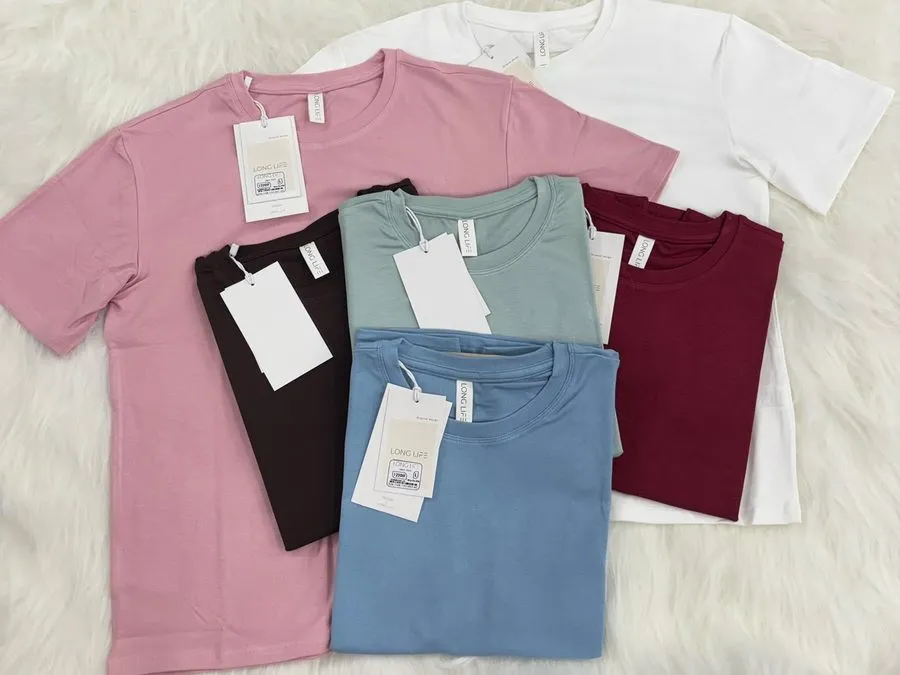
- 100% cotton. Soft, breathable and absorbent, with the most natural feel and the widest print compatibility. It shrinks more than blends unless the fabric is compacted, and it creases and fades faster.
- CVC (chief value cotton). Cotton is the majority fibre, usually 60/40 or 80/20 cotton-polyester. It keeps most of cotton’s hand-feel while the polyester adds strength, colour life and shrink resistance.
- Poly-cotton (PC or TC). Polyester is the majority fibre, typically 65/35 poly-cotton; 50/50 sits between the two. The most durable and usually the cheapest to run, quick-drying and shape-holding, with a more synthetic feel and less breathability.
How do cotton, CVC and poly-cotton compare?
100% cotton is the softest and most breathable and gives the best DTG prints, but it shrinks most when uncompacted and fades soonest. Poly-cotton is the reverse: the lowest shrinkage, best colour life and lowest relative fabric cost, with a more synthetic feel and a higher pilling risk. CVC sits in the middle.
| 100% cotton | CVC (60/40) | Poly-cotton (65/35) | |
|---|---|---|---|
| Hand-feel | Softest, most natural | Close to cotton | Smoother, more synthetic |
| Breathability in heat | Best | Good | Moderate |
| Shrinkage (uncompacted) | Highest | Lower | Lowest |
| Pilling | Low | Some risk | Higher risk |
| Colour life over washes | Fades soonest | Better | Best |
| DTG printing | Best | Workable, less vibrant | Poor |
| Screen print (plastisol) | Excellent | Excellent | Good, with low-bleed inks |
| Relative fabric cost | Highest | Middle | Lowest |
Two rows deserve an explanation. Pilling is higher in polyester-rich fabric because polyester fibres are strong: the little balls of fibre that form on the surface stay anchored instead of breaking off. Low-bleed inks matter because the disperse dyes used on polyester can migrate into a light print at curing temperatures, turning a white logo pink on a red shirt. Your decorator will know; tell them the composition before they quote.
Why do fabric blends behave differently in the dye house?
Cotton and polyester take different dye classes, so a blend is effectively dyed twice, once for each fibre. That makes shade matching slightly harder, and it is why heather and melange colours are often made from blended or pre-dyed fibres rather than piece-dyed. In practice:
- Approve a lab dip on the actual blend, not on a cotton swatch.
- Expect heather colours to have their own composition. A range where the solids are 100% cotton and the heather grey is a cotton-poly blend is normal, but it changes the care label.
- For reorders, keep one approved standard per colour and ask for the dye lot on each shipment.
Does the fabric blend change a t-shirt’s import duty?
Yes, in some markets. Customs classifies a knitted garment by the fibre that predominates by weight. In the United States the general rate is 16.5% on cotton T-shirts and 32% on man-made-fibre T-shirts. In the UK and Canada the blend does not change the 0% position for Nepali tees, on the conditions set out below.
Under the Harmonized System’s textile notes, a blend is treated as if it were made wholly of the fibre that weighs most. If two fibres weigh exactly the same, the garment goes to the heading that comes last in numerical order, which for cotton and polyester is the man-made fibre side. So:
| Blend | Treated as | T-shirt subheading |
|---|---|---|
| 100% cotton, 80/20 or 60/40 CVC | Cotton | 6109.10 |
| 50/50 cotton-poly | Man-made fibre (equal weights) | 6109.90 |
| 65/35 poly-cotton | Man-made fibre | 6109.90 |
Whether that matters depends on the market:
- United States: a big difference. The general rate on cotton T-shirts (6109.10.00) is 16.5%; on man-made-fibre T-shirts (6109.90.10) it is 32%. For US-bound programmes, a switch from 65/35 PC to a 60/40 CVC can roughly halve the duty rate. Nepal has no US preference, so these rates apply to Nepali goods too.
- UK: no difference in the standard rate. Both cotton (6109100010) and man-made-fibre T-shirts (6109902000) pay 12%, and both are 0% from Nepal under the DCTS while Nepal is a least-developed country (LDC).
- Canada: T-shirts of cotton and of other fibres (6109.10 and 6109.90) are both on the list that qualifies for the Least Developed Country Tariff when sewn in an LDC, so the blend does not change the 0% position from Nepal while it lasts.
Declare the composition honestly on the invoice. Customs can test fibre content, and a mis-declared blend is the importer’s problem. Our HS code guide covers classification in more detail; confirm the exact line with your customs broker.
Which blend is best for which kind of t-shirt?
Match the blend to how the tee is sold, printed and washed. Premium retail and DTG-printed tees suit 100% cotton, everyday merch suits CVC 60/40, and uniforms and workwear suit CVC or PC. For US-bound programmes, keep cotton as the chief-weight fibre if you can. For a soft, vintage look, consider tri-blend.
- Premium retail tee, fashion basics: 100% combed ring-spun cotton, compacted. The feel is the product. Why combing matters for print.
- Everyday merch and basics with lots of washes ahead: CVC 60/40, which keeps a cotton feel and ages better.
- Uniforms, workwear, schoolwear: CVC or PC, chosen by how the garment is washed and worn. The uniform blend guide goes role by role.
- DTG-printed ranges: 100% cotton, or as close as you can get.
- US-bound programmes: keep cotton as the chief-weight fibre if you can, for the duty reason above.
- Soft, vintage-look fashion tees: consider tri-blend instead.
What fabric spec should you send your t-shirt factory?
Send a written spec with the composition by percentage for every colour, the yarn type for the cotton part, the construction and GSM with a tolerance, and a shrinkage limit. Add any pilling, colour-fastness or certification requirements. Heather colours often have their own composition, so confirm it colour by colour.
- Composition by percentage, per colour (for example: “60% cotton / 40% polyester; heather grey 55/45, confirm”).
- Yarn type for the cotton part: combed or carded, ring-spun or open-end.
- Construction and GSM with a tolerance (for example, single jersey 180 gsm ±5%).
- Shrinkage limit after washing, and whether the fabric is compacted. The shrinkage guide.
- Pilling and colour-fastness requirements if the garment will be washed hard.
- Certification if you need it, such as OEKO-TEX, or a recycled-content claim that needs its own paperwork.
We cut and sew t-shirts in cotton, CVC and poly-cotton at our factory in Gaindakot, Nepal. We source fabric to your spec from established mills, and you choose: our regular mills, OEKO-TEX-certified fabric, or a mill you nominate. We confirm the mill and its country before you order. See our t-shirt range or send us your blend and target market for a quote.
Frequently asked
What is CVC fabric?
What is the difference between PC and CVC fabric?
Is CVC better than 100% cotton?
Is CVC good for kids’ clothing?
What is the difference between CVC and tri-blend?
Why is my heather grey a different composition from the other colours?
About the author
Santosh Rijal runs Trishakti Apparel, the export knitwear factory his family built on three decades in Nepal’s fashion trade. He writes about sourcing, duty and production from the factory floor in Gaindakot.
LinkedIn ↗