Private label · Quality
Tri-blend vs CVC vs cotton for decorators: choosing blanks by print result
The decorator’s fabric decision: how 100% cotton, CVC and tri-blend differ in feel and drape, how each takes plastisol, water-based and discharge screen print, DTG and transfers, where polyester dye migration and pilling come in, how rayon is labelled, and which base to choose per decoration method.
Decorators choose fabric twice: once for the garment, once for how ink behaves on it. Cotton, CVC and tri-blend cover most of the decorated market, and they print very differently. Matching the base to the job is what separates a shirt the customer reorders from a reprint request.
What are the three main blank bases for decorators?
The three bases that cover most of the decorated market are 100% cotton, CVC and tri-blend. Cotton is a single fibre with the widest decoration window; CVC is a cotton-majority cotton-polyester blend; tri-blend mixes polyester, cotton and rayon, usually knitted as a light single jersey with a heathered surface.
- 100% cotton. One fibre, so every ink system and every dye behaves predictably. The widest decoration window, and the reference point for colour.
- CVC (chief value cotton). Cotton-majority cotton-polyester, most often 60/40 or 80/20. Close to cotton in the hand, more stable in the wash, and usually cheaper than 100% cotton. PC or poly-cotton, typically 65/35 polyester-majority, is a different fabric. The cotton, CVC and PC guide.
- Tri-blend. Polyester, cotton and rayon. A common ratio is 50/25/25, and mills vary it. It is usually knitted as a light single jersey, with a fluid drape and a heathered surface.
How is the rayon in a tri-blend labelled?
Rayon is the generic fibre name in the US; the FTC’s textile guidance notes that the ISO name for the main form of rayon is viscose and that either may be used. In the EU, only the fibre names listed in Annex I of Regulation (EU) No 1007/2011 may be used on labels, and viscose is one of them.
Modal and lyocell have their own entries, so a tri-blend made with either is labelled with that name. “Bamboo” is usually rayon made from bamboo pulp, and the FTC says it should be labelled as rayon, or “rayon made from bamboo”, not as bamboo.
The label follows the actual composition, which can differ by colour, especially heathers. Get it from the mill’s specification before you print care labels or product listings.
How do cotton, CVC and tri-blend differ in feel and drape?
Cotton feels dry and crisp and holds a boxy shape. CVC feels close to cotton, a little smoother, and keeps its shape through more washes. Tri-blend is the softest and most fluid: it drapes and clings, which suits fitted fashion cuts and not structured streetwear.
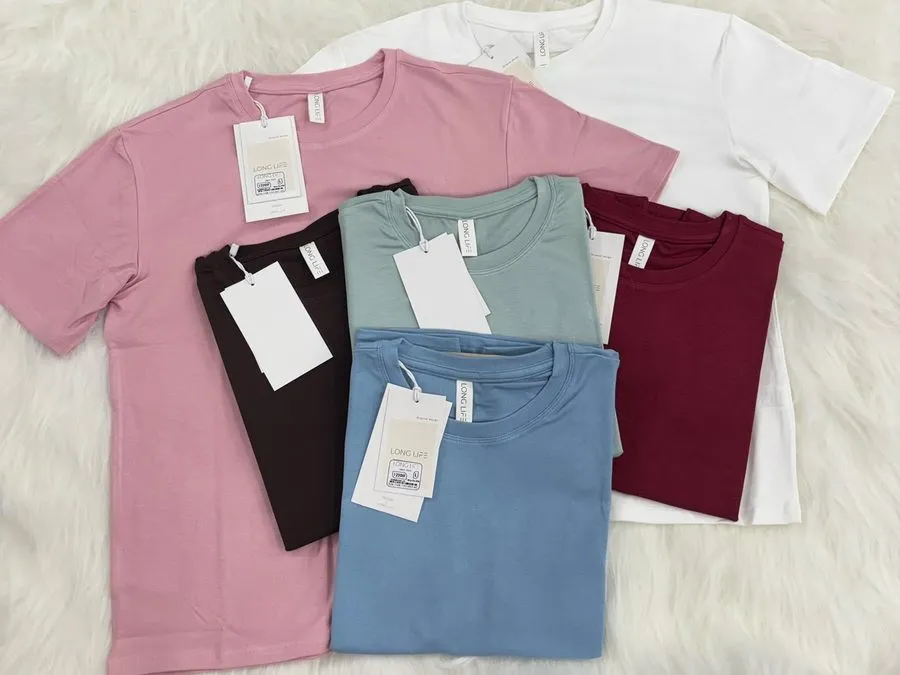
The heather comes from the fibres taking dye differently. Cotton and rayon take one dye class and polyester another, so depending on how the fabric is dyed, the fibres end up in slightly different shades. For decorators, that background lowers print contrast and hides slight misregistration, which is part of the vintage appeal.
How does each base take plastisol, water-based and discharge ink?
On 100% cotton every ink behaves predictably: plastisol is bold and opaque, water-based is soft and sharp, and discharge gives the strongest result if the dye is dischargeable. CVC also prints bold but needs low-bleed inks on bright and dark shades, and only its cotton discharges. Tri-blend takes water-based ink with a soft, vintage look and needs a careful cure.
| Ink | 100% cotton | CVC | Tri-blend |
|---|---|---|---|
| Plastisol | Bold, opaque, predictable | Bold; low-bleed inks on bright and dark shades | Solid but stiffer on a light fabric; low-bleed inks and a careful cure |
| Water-based | Soft, sharp, bright on light shades | Good; slightly less saturated | Soft, broken, vintage |
| Discharge | Strongest result, if the dye is dischargeable | Partial: only the cotton part discharges | Heathered, faded effect: the polyester keeps its colour |
Two practical points. Discharge only works on dyes that can be discharged, so if you plan to discharge print, say so before the fabric is dyed and approve a strike-off. And on any fabric with polyester, the cure matters: enough heat to cure the ink, not so much that it drives dye migration or marks the fabric.
Which base works best for DTG and heat transfers?
DTG pigment inks and pretreatments are designed around cotton and other cellulose fibres. Cotton gives the brightest, sharpest result. CVC works, a little less vivid. Tri-blend prints muted by nature, and the white underbase on dark tri-blend can feel heavy on such a light fabric. Heat transfers, including DTF, are the most fibre-tolerant option and work on all three.
On polyester content, choose low-temperature transfers where you can, and test for dye migration. How each decoration method works.
How do dye migration, pilling and wash life differ by base?
Dye migration rises with polyester content and with bright or dark shades, and pilling is usually higher on polyester blends than on cotton. For wash life, CVC usually holds shape and colour best, cotton needs compacting to control shrinkage, and tri-blend wants gentler care because rayon is weaker when wet.
- Dye migration rises with polyester content and with bright or dark shades: a red tri-blend at 50% polyester is a higher risk than a red 80/20 CVC. Use low-bleed inks and a blocker underbase, and strike off on the bulk colour.
- Pilling is usually lowest on cotton and higher on polyester blends, because the strong polyester fibres hold the pills on the surface. Tri-blends, often light and loosely knitted, can pill noticeably.
- Wash life. CVC usually holds shape and colour best; cotton needs compacting to control shrinkage; rayon is weaker when wet, so tri-blend wants gentler care. Shrinkage and compacting explained.
Which costs more: cotton, CVC or tri-blend?
In general terms, and prices move with fibre markets: CVC is often the cheapest of the three at the same weight, cotton sits in the middle and rises with better yarn, and tri-blend usually costs the most, because it uses three fibres and is made by fewer mills. Why yarn quality changes print and price.
Which base should you choose for each decoration method?
For bold plastisol, choose cotton or CVC; for soft water-based and for discharge prints, cotton; for photographic DTG, combed ring-spun cotton; for DTF and heat transfers, any of the three. Embroidery suits heavier cotton or CVC, and uniform and promo work suits CVC. Tri-blend also works where you want a softer, vintage or deliberately faded look.
| Decoration | First choice | Also works | Watch out for |
|---|---|---|---|
| Plastisol, bold spot colour | Cotton or CVC | Tri-blend, for a softer look | Dye migration on bright and dark blends |
| Water-based, soft hand | Cotton | Tri-blend, for vintage | Lower saturation on blends |
| Discharge | 100% cotton | CVC or tri-blend, for a deliberate faded look | Dischargeable dyes; strike-off first |
| DTG, photographic | Combed ring-spun cotton | CVC | Muted colour on tri-blend |
| DTF and heat transfer | Any of the three | – | Cure temperature on polyester |
| Embroidery | Heavier cotton or CVC | – | Puckering on light tri-blend jersey |
| Uniform and promo | CVC | Cotton | Pilling on high-polyester blends |
Can decorators buy these bases direct from a factory?
Yes. Catalogue blanks lock you into catalogue fabrics. Factory-direct, the base becomes part of your spec: GSM, blend, yarn, and your own or tear-away labels. At Trishakti Apparel the minimum is 200 pieces per style and colour, with 1,000 pieces in total per order, which can be split across sizes. When buying blanks direct pays.
We are a cut-and-sew factory in Gaindakot, Nepal, and we don’t hold fabric stock. We source fabric to your spec from established mills, and you choose: our regular mills, OEKO-TEX-certified fabric, or a mill you nominate. We confirm the mill and its country before you order, and tri-blend depends on a mill offering your ratio. Samples take 7–14 days after tech-pack review. Print and embroidery are done by partner decorators, or you decorate the blanks yourself. Send us your best-selling blank and your decoration method, and we’ll spec the equivalent or the upgrade.
Frequently asked
What is a tri-blend shirt?
Is tri-blend good for screen printing?
Can you DTG print on tri-blend?
Why do tri-blend and CVC prints sometimes turn pink or grey?
Is bamboo fabric a tri-blend?
About the author
Santosh Rijal runs Trishakti Apparel, the export knitwear factory his family built on three decades in Nepal’s fashion trade. He writes about sourcing, duty and production from the factory floor in Gaindakot.
LinkedIn ↗