Private label · Sourcing
Buying blanks direct from the factory: a guide for decorators, promo distributors & uniform suppliers
The blank garment is a decorator’s single biggest cost — and blank prices keep rising. When does importing custom blanks direct from a factory beat buying from a next-day wholesaler? An honest guide with real numbers: costs, MOQs, lead times, duty, and a spec checklist.
If you screen print, embroider, or run a promo or uniform business, you already know the quiet truth of your P&L: the blank garment is usually your single biggest cost line — often more than the decoration itself. On a mid-range hoodie, the blank is commonly over half the pre-margin cost of the finished piece. So here’s the question worth asking once your volume grows: should you keep buying every blank from a catalogue wholesaler, or start ordering your core styles direct from a factory — with your own label sewn in at source? Here’s the honest answer, with the numbers.
How are rising blank costs squeezing decorators?
Decorators are being squeezed from both ends. Printing United Alliance’s State of the Decorated Apparel Industry report (winter 2026) found operating costs rose about 8% while decorators managed price increases of only about 7% — and roughly half of shops named substrate (blank) costs among their top concerns.
Cotton prices are forecast to rise again in 2026/27, and the big blank brands have been open about passing “pricing initiatives” into the channel. The blank price is set far upstream of you — unless you go upstream yourself.
For scale: in the UK trade, a budget cotton tee runs roughly £2–3.50 ex VAT through open wholesale channels, a premium organic tee around £4.70, and a standard 280 gsm blend hoodie £12–17. Every one of those prices carries the brand’s margin and the distributor’s margin on top of a factory price — that’s the service premium you pay for next-day stock.
Where do catalogue blanks actually come from?
The big blank brands don’t make garments in the markets they sell them: Gildan produces mainly in Honduras and Bangladesh; Fruit of the Loom serves the European imprint market from a purpose-built factory in Morocco; Stanley/Stella makes about 98% of its range in Bangladesh; AS Colour produces mostly in Bangladesh and China; Continental Clothing runs its own factory in India.
It’s worth knowing what you’re really buying: you are already buying Asian and African factory production — through two extra margins and someone else’s label. Buying direct is the same supply chain with the middle steps removed.
When does buying blanks factory-direct make sense, and when doesn’t it?
Next-day wholesalers are genuinely good at what they do: thousands of styles in stock, no minimums, delivery tomorrow. A factory can’t do that, and you shouldn’t believe one that says it can. Factory-direct means a real MOQ (ours starts at 200 pieces per style and colour, with 1,000 pieces in total per order), a production-plus-shipping lead time measured in weeks, and cash committed to stock. The switch pays when:
- You reorder the same core styles in predictable volume — around a thousand pieces or more per style across the year.
- You already relabel garments for your own brand, or pay someone to — the custom label arrives sewn in at the factory instead.
- You need a spec the catalogue doesn’t carry: a specific fabric weight, a boxy heavyweight cut, a fit your customers keep asking for.
- You sell under your own brand, where “our own blank” reads as a better product — and earns a better margin — than a decorated catalogue tee.
The smart structure for most decorators is a complement, not a replacement: run your repeat styles factory-direct at factory prices, and keep your wholesaler account for fill-ins, odd sizes, and rush jobs. You keep the service where service matters and take back the margin where volume lives.
What do decorators gain by ordering blanks from the factory?
At the factory you get your own label sewn in at source, your own spec for fabric weight, fit and colours, a print-ready garment by design, shade continuity managed through lab dips and single dye lots, and pre-production blanks shipped ahead of bulk so you can test your own decoration. In detail:
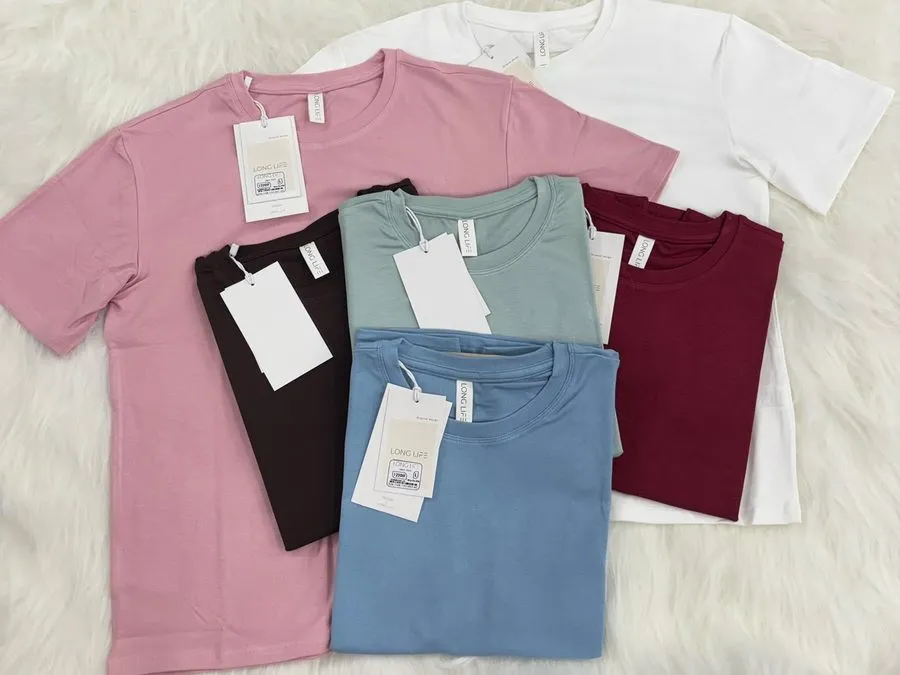
- Your own label, sewn in at source — no per-piece relabelling cost, with fibre-content labels done compliantly for the EU and UK from day one.
- Your spec: fabric weight and hand-feel (including the 200–240+ gsm heavyweight tees and 300+ gsm fleece the streetwear market now expects), your fit, your colours.
- A print-ready garment by design: combed ring-spun cotton for clean screen and DTG results, side-seamed construction, shoulder-to-shoulder taping, tear-away or unlabelled necks if you relabel.
- Shade continuity managed properly — approved lab dips, single dye lots per order, and your approved sample kept as the standard for reorders.
- Pre-production blanks shipped ahead of bulk, so you can test your own pretreatment, inks, and embroidery before a container is ever packed.
What import duty do Nepal-made blanks pay?
Origin decides your landed cost. Nepal-made knits enter the UK, EU, and Canada at 0% import duty under preference schemes for least-developed countries — with single-transformation rules, so the 0% holds even with imported fabric. The same garment from China pays 12% into the UK and EU and 18% into Canada:
| Market | Nepal-made knits | Same garment from China |
|---|---|---|
| United Kingdom | 0% (DCTS) | 12% |
| European Union | 0% (EBA) | 12% |
| Canada | 0% (LDCT) | 18% |
The honest fine print: Bangladesh enjoys the same 0%, and since July 2026 India enters the UK duty-free under the new UK–India trade agreement — so against those origins our case rests on low MOQ, flexibility, and attention, not duty. But against China the gap is a real 12–18 points, India still pays 12% into the EU (the EU–India agreement was concluded in January 2026 but is not yet signed or in force), and UK access is confirmed to at least 2029, with the scheme designed to preserve garment preferences beyond graduation. Full duty breakdown here.
Freight is the trade-off to plan for: Nepal is landlocked, so sea shipments route via Indian ports — typically 6–8 weeks from our gate to a European port, and improving (a new direct Kolkata–Biratnagar rail cargo service opened in July 2026, cutting exporters’ logistics costs meaningfully). Direct import is for the styles you can forecast, planned on a buying calendar — not for Friday’s rush order.
What should the spec for a first custom-blank order cover?
Your first custom-blank order should pin down eight things with the factory: fabric composition and GSM, construction details, labels, testing documents, shrinkage and twist tolerances, lab-dip approval and dye lots, a print test on pre-production blanks before bulk approval, and staged payment terms rather than 100% upfront. The checklist:
- Fabric: composition and GSM in writing (e.g. 100% combed ring-spun cotton, 220 gsm) — and ask what the factory recommends for your decoration method.
- Construction: side-seamed or tubular, shoulder taping, collar spec, stitch details.
- Labels: your woven or printed label, or tear-away — and confirm fibre-content labelling meets EU/UK rules.
- Testing: OEKO-TEX certified fabric or test reports you can keep on file for product-safety documentation.
- Tolerances: agreed shrinkage and twist limits after wash, checked at inspection.
- Colour: lab-dip approval before bulk, one dye lot per order, shade standard retained for reorders.
- Print test: pre-production blanks sent to you for a strike-off on your own equipment before bulk approval.
- Terms: staged payment against inspection and documents — never 100% upfront.
If you’re buying fifty mixed pieces a week, stay with your wholesaler — genuinely. But when you find yourself reordering the same styles month after month, the two margins baked into every catalogue blank are margin that could be yours.
We make blank and private-label knits — tees, polos, hoodies, sweats — from 200 pieces per style and colour (1,000 per order), with your label sewn in and duty-free access to the UK, EU, and Canada. Tell us the styles you reorder most and we’ll quote them landed, so you can compare against your wholesale price line by line.
About the author
Santosh Rijal runs Trishakti Apparel, the export knitwear factory his family built on three decades in Nepal’s fashion trade. He writes about sourcing, duty and production from the factory floor in Gaindakot.
LinkedIn ↗