Private label · Sourcing
Heavyweight and oversized tees: sourcing 240 gsm blanks for your streetwear brand
Heavyweight t-shirts (220–300 gsm) are a popular blank category — the boxy, substantial tees streetwear customers now expect. What “heavyweight” actually means, why catalogue options run out fast, and how to get a custom heavyweight blank made to your spec, from 200 pieces per style and colour.
Pick up any serious streetwear tee from the last two seasons and you’ll feel it before you see it: weight. The industry trade press has called heavyweight tees the dominant blank trend of 2025–26, and for a simple reason — when a customer picks up a shirt with real substance, it reads as a better product before they ever look at the price tag. If you’re building a brand on that feeling, here’s what “heavyweight” actually means, and how to source it.
What GSM counts as a heavyweight t-shirt?
Heavyweight tees run at 200–240 gsm, used for premium basics, boxy fits and embroidery-friendly styles, and ultra-heavy tees at 240–300+ gsm, for structured, oversized streetwear. For comparison, the classic everyday midweight tee, the weight of most catalogue basics, is 150–180 gsm, and lightweight tees are 100–150 gsm.
| Weight class | GSM | Where it’s used |
|---|---|---|
| Lightweight | 100–150 gsm | Budget promo tees, base layers |
| Midweight | 150–180 gsm | The classic everyday tee — most catalogue basics |
| Heavyweight | 200–240 gsm | Premium basics, boxy fits, embroidery-friendly |
| Ultra-heavy | 240–300+ gsm | Structured, oversized streetwear; “luxury” hand-feel |
The trend pairs weight with cut: oversized, boxy, drop-shoulder silhouettes need a fabric with enough body to hold the shape — a 150 gsm jersey collapses; a 240 gsm one drapes with structure. That’s why the move to heavyweight and the move to relaxed fits arrived together. (New to GSM? Here’s our full fabric-weight guide.)
How do you spec an oversized, drop-shoulder tee?
An oversized tee is a pattern, not just a bigger size, so the tech pack has to describe the shape. These are the points to put on it:
- Shoulder: the shoulder width and how far the seam drops below the natural shoulder point. This is what makes it read as “drop-shoulder”.
- Body: chest width and body length. Boxy fits are wide for their length; longline fits are the opposite.
- Sleeve and armhole: sleeve length and opening, and armhole depth, which oversized fits usually deepen.
- Neck rib: its width and knit (1×1 or 2×2 rib). Heavier bodies usually take a wider rib, often 2–3 cm, so the neck lies flat.
- Fabric: composition, GSM with a tolerance (±5% is common) and a shrinkage limit, so the boxy shape survives washing.
- Sizes: oversized ranges often run fewer sizes; set the size range and the grading between them.
Approve the sample in the bulk fabric weight and wash it before you sign off: a heavyweight fit that looks right unwashed can shrink out of shape.
Is a heavyweight tee worth the extra cost for a brand?
A heavier blank costs more to make, but the retail premium it commands is far larger than the cost difference. Weight is one of the few quality signals a customer can feel instantly, in hand, without being told, which is why brands increasingly split their range: midweight for essentials, heavyweight for the drops that define the brand.
On cost, a 240 gsm tee uses about a third more fabric by weight than a 180 gsm one (240 ÷ 180 = 1.33), so the fabric line rises by up to about a third, a little less if the heavier jersey is knitted from a coarser yarn, which costs less per kg.
Heavyweight also decorates better. A heavier, tighter knit is more stable under a multi-colour screen print, and it carries dense embroidery — a left-chest crest or a big back-piece — without puckering. If embroidery is part of your look, weight is your friend.
Why are heavyweight blanks hard to find in catalogues?
The big blank catalogues were built around the 150–190 gsm workhorse tee, and while heavyweight options now exist, the segment moves fast: the specific weight, fit, and colour you want is exactly what sells out — and an entire ecosystem of specialist “premium blank” brands has sprung up to fill the gap, at premium-blank prices.
When your brand’s signature is the garment itself, building it on someone else’s blank has a ceiling: same fit, same fabric, same tee as everyone else — with your print on it.
What does a custom heavyweight blank give your brand?
A custom blank gives you your own weight and hand-feel, from 200 gsm upwards in combed ring-spun cotton, your own fit and neck rib, your label sewn in at the factory, matching fleece cut to the same fit language, and colour that repeats across drops through approved lab dips and retained shade standards.
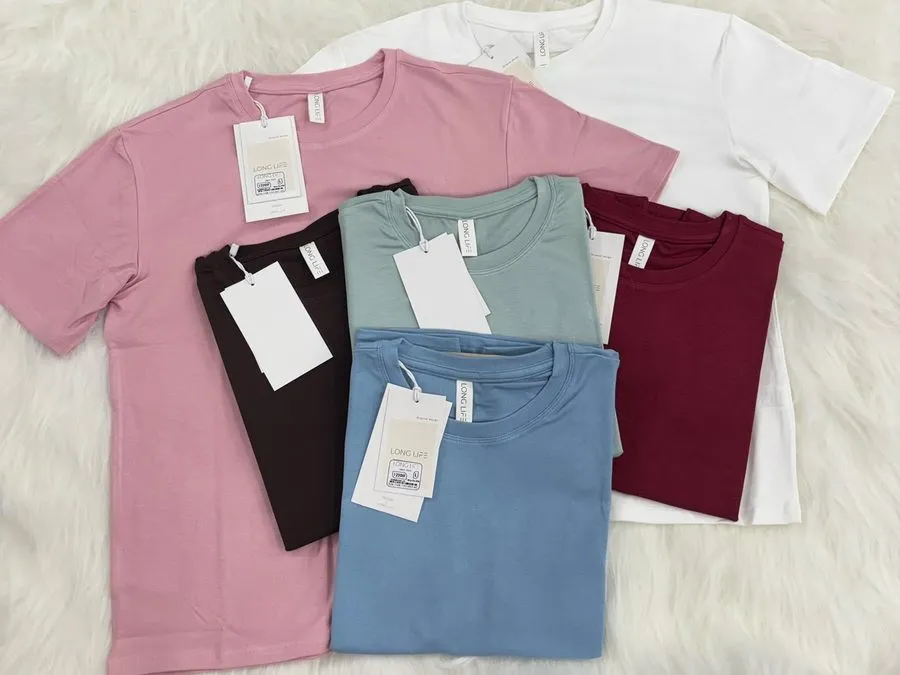
- Your exact weight and hand-feel — 200, 220, 240 gsm or heavier, in combed ring-spun cotton that prints cleanly.
- Your fit: your boxy cut, your drop-shoulder, your neck rib — from your pattern or developed with you.
- Your label sewn in at the factory, not a catalogue brand’s tag cut out and replaced.
- Matching fleece: 300–400+ gsm brushed or loopback hoodies and crews cut to the same fit language.
- Repeatability: approved lab dips and retained shade standards, so your black stays your black across drops.
What minimum order and duty apply to heavyweight tees from Nepal?
Custom blanks usually mean big minimums — that’s the catch. Ours start at 200 pieces per style and colour (1,000 in total per order), built for exactly this kind of brand. And origin matters to your landed cost: Nepal-made knits enter the UK, EU, and Canada at 0% import duty versus 12–18% from most large garment origins — a real gap on a premium garment.
Here’s the duty breakdown, and here’s how low-MOQ production works.
Making oversized tees for an Indian brand?
Indian streetwear and D2C labels can have heavyweight and oversized tees made with us in Nepal on the same terms as any Indian buyer:
- 0% basic customs duty when the garments meet the Nepal–India Treaty of Trade origin rules. IGST applies, 5% up to Rs 2,500 per piece, and is normally taken as input credit.
- Indian fabric counts as local under the treaty, so we can make your tees in Indian heavyweight jersey.
- At your door within 10 days of dispatch, by road, from 200 pieces per style and colour.
- Pay in INR or USD by bank transfer (TT) or Letter of Credit. The Nepali rupee is pegged to the Indian rupee, so there is no exchange-rate risk.
Work out the landed cost in rupees with our Nepal to India import duty calculator, compare us fairly with Tirupur, or see our page for Indian brands.
A heavyweight tee is the rare product where the customer can feel your quality decision in the first two seconds. It deserves better than being the same blank your competitor prints on.
We develop and produce custom heavyweight tees and matching fleece for independent brands — see our t-shirt capabilities or send us your target weight and fit and we’ll come back with fabric options and a landed quote.
Frequently asked
What GSM is best for an oversized T-shirt?
What should a tech pack for an oversized tee specify?
Can an Indian brand import oversized tees from Nepal duty-free?
About the author
Santosh Rijal runs Trishakti Apparel, the export knitwear factory his family built on three decades in Nepal’s fashion trade. He writes about sourcing, duty and production from the factory floor in Gaindakot.
LinkedIn ↗