Sourcing · How to
Corporate uniform programmes: a sourcing guide for hotels, restaurants & fleets
Polos and tees are the modern corporate uniform — and the hardest part isn’t the rollout, it’s years of replenishment in matching colours and fragmented sizes. How uniform programmes are actually bought, the pain points that break them, and when factory-direct production fixes the maths.
The corporate uniform has casualised: front-of-house hotel teams, fast-casual restaurant staff, delivery riders, and retail floors increasingly wear embroidered polos, tees, and soft-shell layers — comfortable, brandable knits in place of stiff tailoring. That shift moves uniform buying squarely into a knit factory’s territory. But uniform programmes have a very particular shape, and most sourcing advice ignores it. Here’s how they actually work — and where the money leaks.
How are corporate uniform programmes really bought?
Corporate uniform programmes are bought on multi-year contracts, typically two to five years, through managed-service suppliers or public-sector frameworks. The rollout of an initial kit per employee is the visible part, but the real programme is replenishment: smaller, repeating orders for years, with sizes that fragment brutally.
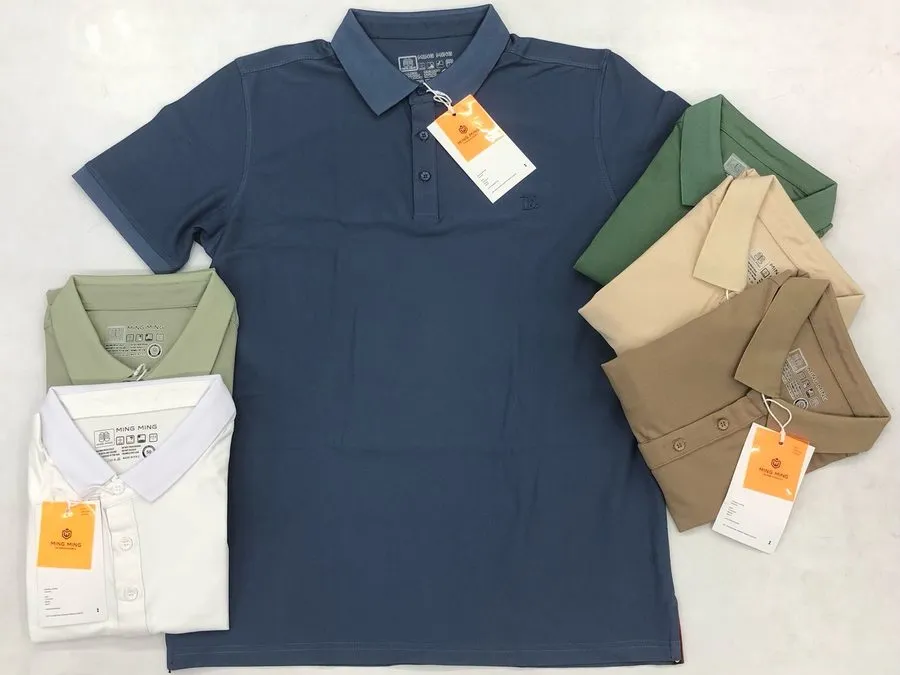
- Contracts run multi-year — typically two to five — whether through managed-service suppliers or public-sector frameworks.
- The rollout is the visible part: an initial kit per employee (a polo-and-sweat set typically lands around £30–75 per head at trade pricing).
- The replenishment is the real programme: every new starter, every worn-out garment, every site opening — smaller, repeating orders for years.
- Sizes fragment brutally: a realistic 500-piece rollout splits roughly 10% S / 30% M / 30% L / 20% XL and a long tail of 2XL–4XL at 1–2% each.
What breaks corporate uniform programmes?
Three things break uniform programmes: supplier minimums that distort the size curve, colour drift between dye lots over years of reorders, and staff turnover, which makes per-garment cost on replenishment orders, not the rollout price, the number that decides what a programme truly costs.
First, size-curve maths versus supplier minimums. Wholesale suppliers impose per-size or per-carton minimums, so buyers end up purchasing distorted ratios — overstocking tail sizes to hit MOQs, with the overstock risk on the buyer. A factory cutting to order doesn’t have that problem: we cut your actual curve, tail sizes included, within a ~1,000-piece run.
Second, colour continuity over years. A navy polo bought in year three must match the year-one stock standing next to it on shift. Dye lots drift — a 2–3% shade difference between batches is considered industry-acceptable, which is visible on a uniform line-up. The fix is a discipline, not a promise: approved lab dips held as the master standard, dye recipes kept on file, one dye lot per order, and shade checks at inspection against the retained standard. Ask any prospective supplier to describe exactly this process; if they can’t, the year-three mismatch is already scheduled. There’s a related risk with catalogue garments: styles get discontinued mid-contract, stranding your programme. A factory making your spec can’t discontinue you.
Third, staff turnover is the hidden budget line. UK hospitality turnover runs around 40% a year — every leaver strands an embroidered garment nobody else can wear. That makes per-garment cost on replenishment orders, not the rollout price, the number that decides what a programme truly costs. It also argues for garments that survive: better fabric at +10% cost that lasts twice as long wins the three-year arithmetic every time.
Why do uniform tenders now need a sustainability answer?
Corporate sustainability reporting (CSRD in the EU) is pulling staff clothing into procurement scorecards, and the big end of the market has moved — McDonald’s has rolled out recycled-polyester uniforms; IKEA recycles tonnes of retired staffwear into new products. Mid-market operators increasingly need a sustainability answer in uniform tenders.
Recycled-polyester and organic-cotton knit options, with the fabric certificates passed through, are exactly the kind of answer we can put in writing. How we make responsibly.
Who should source uniforms factory-direct?
Uniform resellers, embroiderers serving multi-site clients, and operators with 150+ staff can run their core polo and sweat lines factory-direct — cut to their size curve, shade-managed for reorders, labels sewn in — and keep a wholesaler account for emergencies. At 0% duty into the UK, EU, and Canada, the landed maths beats catalogue pricing with room to spare.
The biggest UK uniform houses already source this way — the major programme suppliers run their own South Asian sourcing offices, and at least one fast-growing workwear wholesale brand owns its factories in Bangladesh and Pakistan outright. The economics they enjoy are available one tier down. The full direct-vs-wholesale breakdown.
A uniform programme isn’t an order — it’s a promise to match yourself for five years. Choose a supplier whose colour discipline you’ve tested, not one whose catalogue you’ve browsed.
We produce uniform knits — polos, tees, sweats, soft layers — from 200 pieces per style and colour (1,000 per order), cut to your real size curve, with retained shade standards for reorders and your branding applied or embroidery-ready. Schoolwear specifically? That guide is here. Tell us your headcount and colours and we’ll quote the rollout and the replenishment plan together.
About the author
Santosh Rijal runs Trishakti Apparel, the export knitwear factory his family built on three decades in Nepal’s fashion trade. He writes about sourcing, duty and production from the factory floor in Gaindakot.
LinkedIn ↗