Ethics · Sourcing
Ethical garment manufacturing: the questions to ask any factory
Sustainability and ethics are now buyer requirements, not nice-to-haves. Here are the questions on wages, hours, subcontracting, safety, audits and energy that separate responsible factories from greenwashing, with the answers to look for.
Your customers ask where their clothes are made and by whom, and some importers are asked by law. Germany’s Supply Chain Act (LkSG), for example, requires companies with 1,000 or more employees in Germany to carry out human-rights due diligence on their suppliers; the law is currently being revised. Whether the question comes from a customer, a retailer or a compliance team, it lands on you, and you can only answer it if you have asked your factory.
Most factories will tell you they are ethical. The questions below turn that claim into facts you can check. For each one, we say what a good answer looks like and what should worry you, and then give our own answer.
1. What should you ask a factory about pay and the minimum wage?
“Fair wages” is not an answer. Ask for the lowest monthly pay of a new sewing operator and the national minimum wage it is measured against. In Nepal the statutory minimum is NPR 19,550 a month, in force from July 2025. Look for a clear number, paid on time, and willingness to let an auditor check payroll.
Know the difference between a minimum wage, the legal floor, and a living wage, an independent estimate of what a decent standard of living costs in a particular place. A factory that says “living wage” should be able to tell you which benchmark it used.
- Good sign: a clear number, paid on time, and willingness to let an auditor check payroll.
- Warning sign: “our workers are happy”, or no answer at all.
Our answer: every member of our team is paid above Nepal’s statutory minimum wage, on time, every cycle. We don’t claim a living wage, because we have not benchmarked one.
2. What should you ask a factory about working hours and overtime?
Long, compulsory overtime is a known risk in garment work, and it usually starts when a factory has taken on more than it can make. Ask for the normal working week, how overtime is recorded and paid, and whether workers can refuse it, then have your auditor check the answers.
- Ask for the normal working week, how overtime is recorded, how it is paid, and whether workers can refuse it.
- Ask how the factory plans capacity, because realistic capacity is what keeps overtime down.
- On an audit, the auditor compares attendance records with payroll.
Put the same questions to us, and have your auditor check the answers.
3. Who works in the factory, and are they permanent?
Look beyond the headcount. Are workers employed directly and permanently, or through agencies and short contracts? Do women, who are often most of a sewing floor, hold only line jobs or also supervisory ones? At Trishakti Apparel, about 80% of the team are women, all local and permanent, and women hold supervisory roles.
Our answer: about 80% of our team are women, all local and permanent, including two deaf operators who run the same machines to the same standard. Women hold supervisory roles, including our assistant production head and a production supervisor. Why that matters to us.
4. How can you check that no child works in the factory?
A policy is a start; ask how ages are checked at hiring and whether records are kept. Ask the same about any partner who handles your goods. Trishakti Apparel has a strict no-child-labour policy, and you can check it on a visit or an audit.
5. Where exactly will your order be made?
Unauthorised subcontracting is how brands end up with goods made somewhere they have never seen. Ask which steps happen in the factory you are talking to, which go to partners, and who those partners are. At Trishakti Apparel, cutting, sewing, finishing and inspection happen in its own factory; print and embroidery go to partner decorators.
Our answer: cutting, sewing, finishing and inspection happen in our own factory in Gaindakot. Print and embroidery are arranged through trusted partner decorators near Gaindakot, coordinated by our team; ask us which steps of your order involve a partner. Fabric comes from established mills, and you choose: our regular mills, OEKO-TEX-certified fabric, or a mill you nominate. We confirm the mill and its country before you order.
6. Can you see the factory floor as it really is?
Ask for a live video walk-through during working hours, not a polished film. On the call, look for clear aisles and marked exits, fire extinguishers that are reachable, first-aid provision, lighting and ventilation, and drinking water. Weeks of delay, or only photos, is a warning sign.
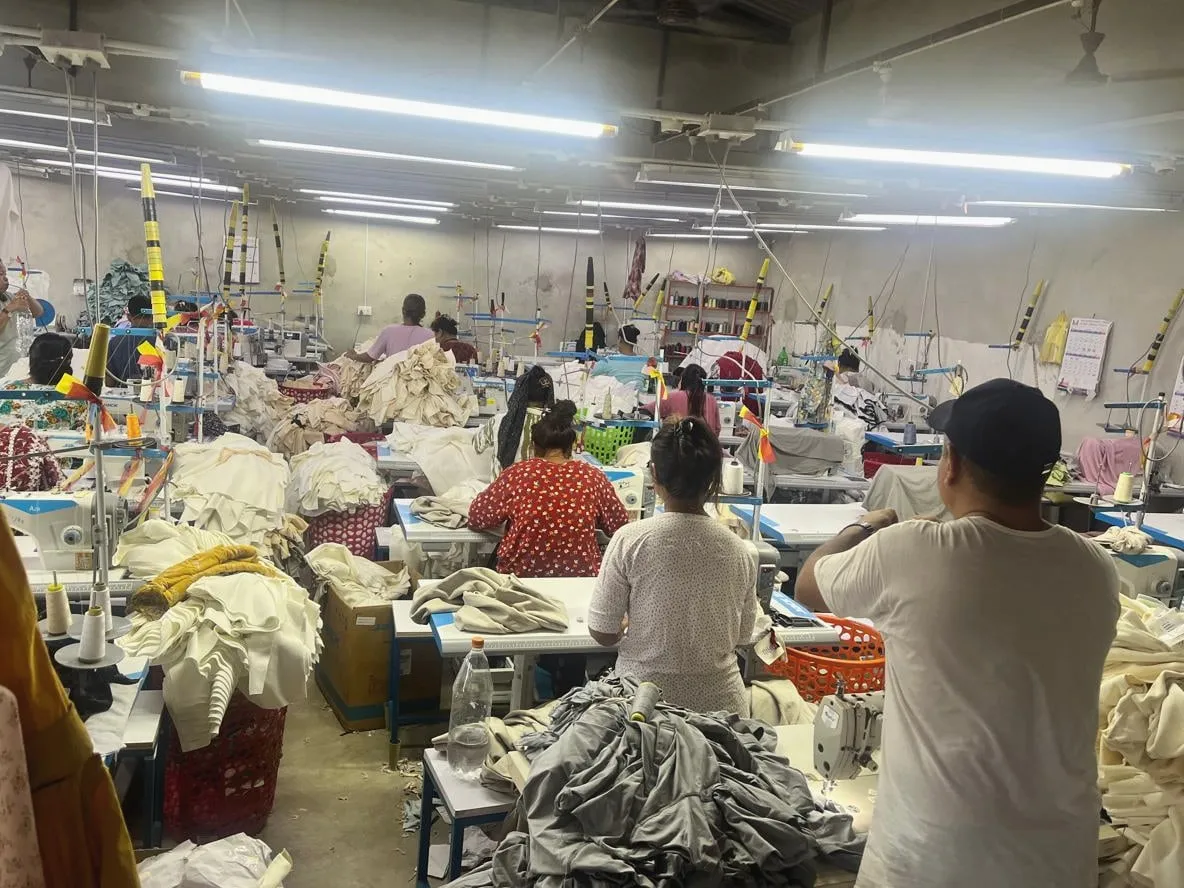
- Warning sign: weeks of delay, or only photos.
We offer video calls and factory walks, and you are welcome to ask to see the floor unedited. You can also visit us in Gaindakot. How to verify a factory remotely.
7. Which audits and certificates does the factory hold, and what do they cover?
Ask for the certificate or report, its date and its scope. Know what each one covers: amfori BSCI and Sedex/SMETA are social audits of the factory; OEKO-TEX Standard 100 certifies the fabric for harmful substances, not the factory; GOTS covers organic fibre through the supply chain. The certifications explained.
Our answer: we don’t yet hold a social certification such as amfori BSCI or Sedex/SMETA. A social compliance audit is in preparation. OEKO-TEX-certified fabric is available on request, sourced from certified mills with the mill certificate passed through to you. We are a licensed exporter with an EXIM code and REX registration, and your audit is welcome any time.
8. What powers the factory, and what happens to the waste?
Ask for real numbers: electricity use from the bills, the source of the power, whether diesel generators run, and where offcuts go. Trishakti Apparel runs on grid power only, with no diesel generator, and its cutting-room offcuts are collected every day and go to a local textile recycler.
Most of the electricity used in Nepal is generated in Nepal from hydropower. It is not all hydro, all year: in 2024/25 about 11% was imported from India, mostly in the dry season. Our energy figures.
Our answer: grid power only, with no diesel generator: 44,044 kWh on our last twelve electricity bills. We cut and sew, so we use no process water; dyeing happens at the fabric mills. Cutting-room offcuts are collected every day and go to a local textile recycler.
How can you tell an honest factory from one that only claims badges?
A factory that claims to be fully certified in everything, and cannot show the documents, is a red flag. One that tells you plainly what it holds, what is in progress and what is not, is usually easier to trust. Honesty counts for more than badges.
Before you pay a deposit, get these in writing:
- The lowest monthly pay, against the legal minimum.
- Working hours and how overtime is handled.
- Which steps happen in the factory, and which go to named partners.
- A live look at the floor, or a visit.
- Copies of any audits or certificates, with dates and scope.
- Access for your own inspector or auditor.
We would rather tell you what is true today than claim badges we haven’t earned. See our compliance status, or book a video call and walk the floor with us.
Frequently asked
What is the difference between a minimum wage and a living wage?
How can I check a factory’s ethics without travelling?
Does Trishakti Apparel hold BSCI, SMETA or WRAP certification?
Is Nepal’s electricity renewable?
About the author
Santosh Rijal runs Trishakti Apparel, the export knitwear factory his family built on three decades in Nepal’s fashion trade. He writes about sourcing, duty and production from the factory floor in Gaindakot.
LinkedIn ↗