Sourcing · Duty-free
Garment industry in Nepal: exports, markets and what is changing in 2026
How big Nepal's garment industry is, where its clothing goes, how much depends on imported fabric, what happened after the quota era, and the trade preferences behind it, from Department of Customs data and dated reporting.
Nepal’s garment industry is a small, export-focused sector that sells mostly to Europe and the United States. In FY 2082/83, which ended in mid-July 2026, Nepal exported Rs 13.07 billion of clothing, about 4% of its total exports, according to Department of Customs figures. Here is what the data shows, where the gaps are, and what it means if you are thinking of buying clothing from Nepal. We are a garment factory in Gaindakot, so we have a stake in this; every figure below names its source, and the sources are listed at the end.
How big is Nepal’s garment industry?
By Department of Customs figures, Nepal exported Rs 13.07 billion of clothing in FY 2082/83, up about 9% on Rs 11.98 billion the year before. That covers all knitted and woven apparel (HS chapters 61 and 62) and is roughly 4% of the country’s Rs 315 billion total exports.
Two different measures are quoted for this industry, and they should not be mixed:
| Measure | Covers | FY 2081/82 | FY 2082/83 |
|---|---|---|---|
| Clothing, HS chapters 61 and 62 (Department of Customs) | All knitted and woven apparel and clothing accessories | Rs 11.98 billion | Rs 13.07 billion |
| “Readymade garments” (trade category reported by The Kathmandu Post) | A narrower commodity group | Rs 8.75 billion, 15.88 million pieces | Not used here |
The Kathmandu Post reported that readymade garment exports “fell 2.39 percent to Rs8.75 billion, with 15.88 million pieces exported, accounting for 3.2 percent of total exports” in FY 2081/82. For the first six months of FY 2082/83, New Business Age reported a further 2.07% fall in that narrower measure; we have not found its full-year figure. Garments’ share of exports also looks small partly because Nepal’s total exports grew 81.8% in FY 2081/82, much of it from re-exported edible oil.
The customs figures are our sums of the Department of Customs export tables for HS 61 and 62, so small rounding differences are possible.
Which countries buy clothing from Nepal?
The United States and Germany each took about a fifth of Nepal’s clothing exports by value in FY 2082/83. The United Kingdom, France and Italy follow, and together Europe is the largest destination. These are our sums of Department of Customs data for HS chapters 61 and 62.
| Market | FY 2082/83 (Rs million) | Share | FY 2081/82 (Rs million) |
|---|---|---|---|
| United States | 2,846 | 21.8% | 2,519 |
| Germany | 2,786 | 21.3% | 2,421 |
| United Kingdom | 1,451 | 11.1% | 1,490 |
| France | 888 | 6.8% | 878 |
| Italy | 665 | 5.1% | 525 |
| Japan | 554 | 4.2% | 552 |
| Netherlands | 389 | 3.0% | 378 |
| Canada | 376 | 2.9% | 293 |
| Australia | 331 | 2.5% | not compared |
| India | 308 | 2.4% | not compared |
US clothing imports from Nepal grew about 13% and Germany’s about 15%, even though the US now applies normal duty. The balance has shifted a long way since the early 2000s: The Kathmandu Post reported that Nepal shipped “87 percent of its readymade garments to the US till 2002”. A SAWTEE study reported by Ratopati in April 2026 estimated that the European Union now takes nearly 48% of Nepal’s garment exports.
Does Nepal make more knitted or woven clothing?
By value, Nepal exports more woven than knitted clothing. In FY 2082/83, woven apparel (HS 62) was Rs 8.74 billion, about two-thirds of the total, and knitted apparel (HS 61) was Rs 4.33 billion, about one-third, according to Department of Customs figures.
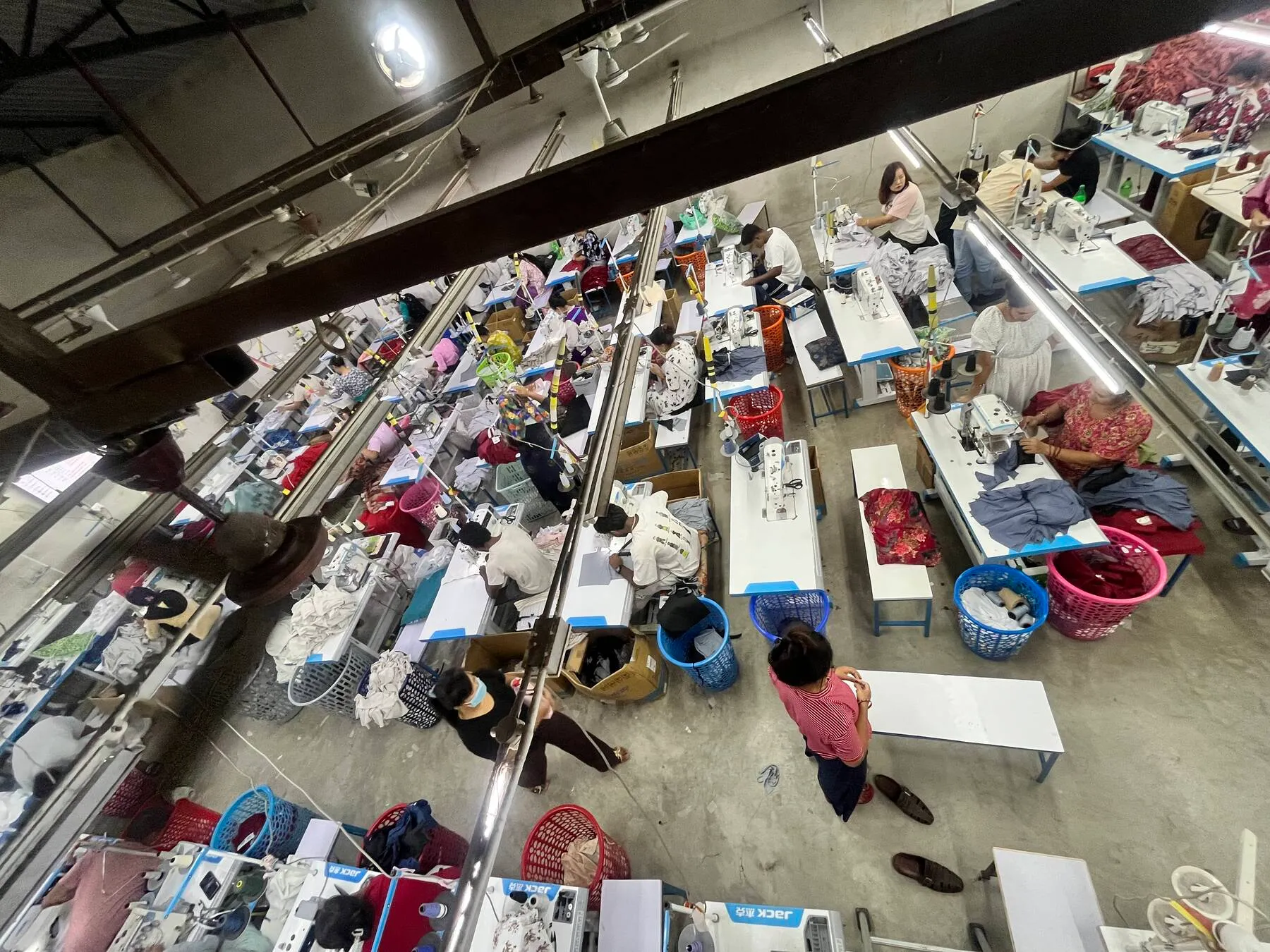
Our own factory is on the knitted side: T-shirts, polos, sweatshirts, hoodies and other knit basics, cut and sewn from fabric knitted to the buyer’s spec.
How much does Nepal’s garment industry depend on imported fabric?
Imported fabric is central to Nepal’s garment trade. Department of Customs data show that in FY 2082/83 about 90% of the knitted fabric Nepal imported came from China by value, and about 10% from India. A SAWTEE survey of 28 export firms found that 66.7% depend on imported fabric.
The two figures measure different things. The customs figure covers the value of imported knitted fabric (HS chapter 60). The survey covers firms and all fabric, including woven, and found 46% of their fabric came from China and 54% from India. Neither tells you how much fabric is made in Nepal. This matters for duty: in the EU, UK, Canada and Japan, garments cut and sewn in Nepal from imported fabric can still qualify as Nepali origin while Nepal is a least developed country. Our guide to single and double transformation explains why.
How many people work in Nepal’s garment industry?
No current official count of garment factories or workers was found. A 2025 report citing the Nepal Readymade Garment Industry Association put it at 100 factories and 35,000 direct jobs. A SAWTEE estimate reported in April 2026 said about 125,000 jobs in the sector could be at risk from LDC graduation.
The gap between those numbers is large, and they measure different things: one counts direct jobs in member factories, the other estimates jobs exposed to a change in trade rules, possibly across textiles as well. Treat both as estimates. The ILO’s 2026 assessment of Nepal’s LDC graduation put the possible export losses at 2.5% to 4.3% of total exports, without a garment job count.
What happened to Nepal’s garment industry after 2005?
Nepal’s garment exports grew under the quota system and fell sharply after it ended. The Kathmandu Post reported that exports “started to collapse after the Multi Fibre Agreement expired in January 2005”, after a period when the US took most of Nepal’s garments. Since then, as the market table above shows, Europe has become the larger destination.
The same report put garment exports in 2000 at about Rs 12 billion a year. SAWTEE’s study, reported by Ratopati, found annual growth of 12.15% from 1994 to 2003 and an average decline of 4.88% a year from 2003 to 2022. These are news-reported figures from studies, not official series.
Which trade preferences do Nepal’s garments get?
While Nepal is a least developed country, its garments can enter the EU, UK, Canada and Japan duty-free if they meet each market’s origin rules. The United States has had no preference programme for Nepal since the Nepal Trade Preference Program expired on 31 December 2025, so normal US duty applies.
| Market | Scheme | Status for Nepal |
|---|---|---|
| European Union | Everything But Arms | 0% duty and no quotas on all goods except arms |
| United Kingdom | DCTS Comprehensive Preferences | Duty-free; a three-year transition after graduation |
| Canada | Least Developed Country Tariff | Duty-free; apparel may use imported yarn and fabric |
| Japan | GSP for least developed countries | Duty-free, quota-free |
| United States | None since 31 Dec 2025 | Normal (MFN) duty |
Nepal was due to graduate from the UN’s least developed country category on 24 November 2026. On 30 October 2026, The Kathmandu Post reported that the UN General Assembly extended Nepal’s preparatory period to 24 November 2029. Our duty status page tracks what each market does after that.
What does this mean if you are buying clothing from Nepal?
Nepal is a niche source, not a volume hub. It suits buyers who want duty-free access to Europe, the UK, Canada or Japan, smaller orders and a supplier they can verify, and who can plan around a landlocked route to the sea. Check each supplier’s product focus and origin paperwork before you order.
- Small industry. Fewer factories means less choice and capacity than Bangladesh or India. Our directory of garment manufacturers in Nepal lists who makes what.
- Duty depends on the market. See how EU, UK and Canadian buyers save duty and what US buyers pay.
- Origin paperwork matters. For the EU, the exporter needs to be REX-registered: what a REX number is and how to check one.
- Plan the route. Sea freight runs through Indian ports: shipping garments from Nepal.
Frequently asked
How big is Nepal's garment industry?
Which countries buy the most clothing from Nepal?
Is clothing from Nepal duty-free?
About the author
Santosh Rijal runs Trishakti Apparel, the export knitwear factory his family built on three decades in Nepal’s fashion trade. He writes about sourcing, duty and production from the factory floor in Gaindakot.
LinkedIn ↗