Compliance · Private label
Relabelling blank garments for your own brand: how to do it right in the UK & EU
Cutting out a catalogue label and sewing in your own is standard practice — but there are rules. What tear-away labels are for, what your replacement label must legally carry in the UK and EU, the responsibilities you take on when you sell under your own brand, and the factory-direct shortcut.
If you decorate blanks and sell them under your own name, you’ve probably relabelled — cut out the catalogue brand’s neck tag and sewn or printed in your own. It’s standard, legitimate practice; some blank brands even design tear-away labels specifically so you can. But relabelling isn’t just a branding step: the moment a garment carries your name, you take on real legal responsibilities. Here’s what has to be on that label, and the mistakes that catch people out.
Is it legal to relabel blank garments?
Yes, relabelling blank garments is standard, legitimate practice, but under conditions. The blank supplier must permit it, you can never leave the original brand on and present the garment as yours, and the legally required information the old label carried must survive onto your new one.
- The blank supplier must permit it. Tear-away tags are an open invitation; check the wholesale terms of any brand you relabel.
- You can never leave the original brand on and present the garment as yours — that’s straightforward misrepresentation.
- The legally required information the old label carried must survive onto your new one. Removing a label is easy; replacing it compliantly is the actual job.
What must a replacement label carry in the UK and EU?
In both the EU (Regulation 1007/2011) and the UK (the same rules retained after Brexit), a textile product must state its fibre composition — using the official fibre names, in a label that is durable, legible, and securely attached. “100% cotton” or “65% polyester / 35% cotton” isn’t decoration; it’s the one legally mandatory line.
Care instructions are legally required in some countries and expected by retailers everywhere — in practice, always include them. Our full labelling guide covers each market.
Does selling under your own brand make you the “manufacturer”?
Under EU product rules, generally yes. This is the part many decorators don’t realise: selling a product under your own name or brand generally puts you in the manufacturer’s shoes, which brings duties such as naming an EU-established responsible person and, in France or the Netherlands, typically textile EPR registration.
Under the EU’s General Product Safety Regulation (in force since December 2024), consumer products — clothing included — need an EU-established responsible person whose details accompany the product, backed by technical documentation you can produce if asked. Sell into France or the Netherlands under your own brand and you’re typically also the “producer” for their textile EPR schemes — registration and eco-contributions on every garment placed on those markets. None of this is a reason not to build a brand; it is a reason to keep your paperwork tidy from day one.
What documentation should you keep on file?
Keep fibre composition confirmation for every style from the actual supplier, chemical-safety evidence such as OEKO-TEX Standard 100 certification or test reports, supplier traceability records showing who made it, where and when, and your own decoration records, because inks and transfers have chemical compliance too.
- Fibre composition confirmation for every style, from the actual supplier — not guessed from a catalogue page.
- Chemical-safety evidence: OEKO-TEX Standard 100 certification or test reports are the de-facto answer buyers and authorities accept.
- Supplier traceability: who made it, where, and when — increasingly asked for as EU textile rules tighten over the next few years.
- Your own decoration records: inks and transfers have chemical compliance too.
Why order blanks direct from a factory instead of relabelling?
Every step above is a per-unit cost and a compliance risk when done shirt by shirt in your workshop. Ordering blanks direct from a factory collapses the workflow: your woven or printed label is sewn in at source, with the fibre-content line done correctly on every piece, backed by the factory’s fabric test reports — and nobody’s tag to cut out.
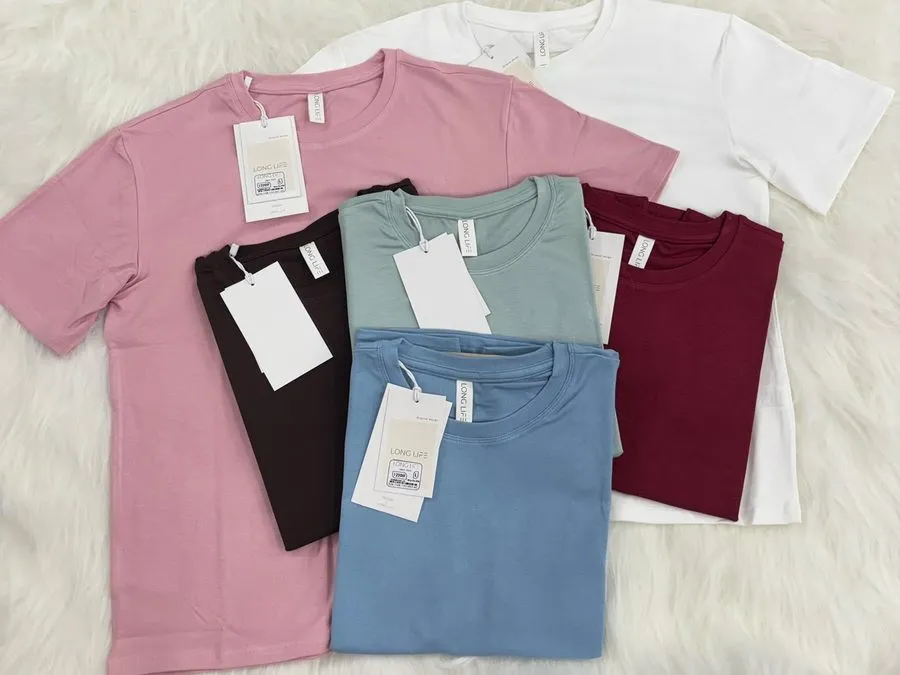
That’s one of the strongest practical reasons decorators move their repeat styles to factory-direct production once volume justifies it. Here’s our full guide to buying blanks direct.
A brand is a promise with your name on it. The label is where that promise becomes a legal fact — get it right once, systematically, rather than shirt by shirt.
We produce private-label knits with your label sewn in and the compliance paperwork supplied — see how private-label production works, or tell us what you relabel today and we’ll quote it made as your own from the start.
About the author
Santosh Rijal runs Trishakti Apparel, the export knitwear factory his family built on three decades in Nepal’s fashion trade. He writes about sourcing, duty and production from the factory floor in Gaindakot.
LinkedIn ↗