China plus one · Sourcing
China Plus One for apparel: is Nepal your second sourcing country?
China Plus One means keeping your main supply base and adding a second country. This guide covers why apparel buyers do it, how to run one programme across two factories without drift in fit, shade or labels, and where Nepal honestly fits as a second source for knit basics – and where it does not.
“China Plus One” means keeping your main supply base and adding a second country, so one disruption cannot stop your whole range. The idea is simple; running it is not. Two factories in two countries drift apart on fit, shade and labelling unless the programme is built to stop that. This guide covers why buyers add a second source, how to keep two factories consistent, and where Nepal honestly fits as the “plus one” for knit basics.
Why do apparel buyers add a second sourcing country?
The main reasons are concentration risk, so that one port closure, policy change or factory problem cannot stop all replenishment; tariff exposure, because duty follows the garment’s origin; lead-time diversification across holiday calendars, peak seasons and shipping routes; and a real benchmark of what your garment should cost and how it should perform.
- Concentration risk. If every core style comes from one country, a port closure, a policy change or one factory’s problem stops your whole replenishment. A second country is insurance you pay for in management time.
- Tariff exposure. Duty follows the garment’s origin, not your brand. In the US, for example, additional Section 301 duties on products of 60 economies took effect on 24 July 2026, including 12.5% on products of China; Nepal is not on that list as of September 2026. Rates like these can change at short notice, and a second origin gives you somewhere to move volume.
- Lead-time diversification. Different countries have different holiday calendars, peak seasons and shipping routes. In Nepal the main festival season, Dashain and Tihar, usually falls in October–November, so ask any factory how its calendar affects your dates.
- A real benchmark. A second factory on the same spec shows what your garment should cost and how it should perform.
Split styles, split volume or split markets?
There are three ways to divide a programme. Splitting by style is simplest, because fit and shade only have to match within one factory. Splitting the same style by volume is most resilient but needs shared specs, sealed samples and tight tolerances. Splitting by market sends each market’s volume from the origin with the better duty position.
| Split | How it works | Strengths | Watch out for |
|---|---|---|---|
| By style | Each factory makes complete styles | Simple; fit and shade only have to match within one factory | A disruption still stops the styles that factory owns |
| By volume | The same style comes from both factories | Most resilient; either factory can take over | Needs shared specs, sealed samples and tight tolerances |
| By market | Volume for each market comes from the origin with the better duty position | Captures preferences where they exist | Two origins in stock; labels and paperwork must match each lot |
A common path is a style split first, then a volume split on one or two core styles once the second factory has proved it can match.
How do you keep two factories consistent?
Your customer only cares that the medium fits like the last one. Two factories stay consistent when they share one master tech pack, written tolerances, sealed reference samples, one fabric specification and one shade standard, backed by side-by-side wash tests, one inspection standard and labels true to each lot. These habits stop drift:
- One master tech pack. The same version, points of measure, measuring method and grading rules at both factories; every change is a new, dated version sent to both.
- Written tolerances. Give each measurement a plus-or-minus tolerance and use the same table in both inspections. As an example only: ±1 cm on chest and body length, ±0.5 cm on sleeve opening. Your fit team sets the real numbers.
- Sealed reference samples. Once a style is approved, seal matching samples for each factory and your inspector, and approve the second factory against the spec and that reference.
- One fabric specification. The same composition, GSM tolerance, shrinkage and twist limits; for the closest match, nominate the same mill for both.
- One shade standard. Approve lab dips from both mills against the same physical standard under the same light source.
- Side-by-side wash tests of both factories’ first samples, and one inspection standard: the same AQL level and defect list, ideally the same third-party inspector.
- Labels true to each lot. Brand, size and care artwork can be shared, but the origin marking must match where each garment was made, so order origin-specific labels. How a private-label trim pack comes together.
Where does Nepal fit as a second source?
Nepal fits as a second source for knit basics: T-shirts, polos, sweatshirts, hoodies and jersey basics. While Nepal is a least-developed country, cotton knit T-shirts, polos and sweatshirts enter the EU, UK, Canada and Japan at 0%, and imported fabric does not stop them qualifying, provided cutting and sewing are done in Nepal.
Products. Knit basics: T-shirts, polos, sweatshirts, hoodies and jersey basics. Mills knit the fabric to spec; we cut and sew it to your tech pack.
Duty position. For cotton knit T-shirts, polos and sweatshirts, while Nepal is a least-developed country (LDC):
| Market | Nepal-made knitwear | Basis |
|---|---|---|
| EU | 0% | Everything But Arms |
| UK | 0% | DCTS Comprehensive Preferences |
| Canada | 0% | Least Developed Country Tariff |
| Japan | 0% | LDC preference |
| United States | 16.5% cotton T-shirts, 19.7% cotton knit polos | MFN only, no preference; no additional Section 301 duty as of September 2026 |
Nepal’s graduation from the LDC category is scheduled for 24 November 2026, and as of 28 September 2026 the UN General Assembly had not decided on Nepal’s request for more time. The EU, UK, Canada and Japan each keep LDC-level access for a transition of up to three years after graduation takes effect. What changes, market by market.
Fabric and origin. The LDC rules in these four markets are single transformation. The EU requires manufacture from fabric, the UK one significant process such as cutting and sewing, Canada cutting and sewing in the LDC, and Japan manufacture from fabrics. Imported fabric, including fabric knitted in China, therefore does not stop our T-shirts, polos and sweatshirts qualifying, provided cutting and sewing are done in Nepal. Single and double transformation explained. We source fabric to your spec from established mills, and you choose: our regular mills, OEKO-TEX-certified fabric, or a mill you nominate. We confirm the mill and its country before you order.
For US buyers there is one more point. Under the Uyghur Forced Labor Prevention Act, US Customs presumes that goods made wholly or in part in Xinjiang are prohibited from import, unless the importer proves otherwise by clear and convincing evidence. We can source your fabric from outside China if you prefer.
Scale and timing. We run 40,000–50,000 pieces a month on 150+ machines, and the minimum is 200 pieces per style and colour, with 1,000 pieces in total per order, which can be split across sizes. Samples take 7–14 days after we review your tech pack, and bulk 25–30 days after sample approval. We quote EXW Gaindakot, FOB Kolkata by sea or FCA Kathmandu by air, and sea freight to Europe takes roughly 6–8 weeks.
When is Nepal not the right fit?
Nepal, and our factory in particular, is not the right fit for very large single orders, quick sea replenishment, US-only programmes chasing a duty preference, or buyers who need social-audit certificates today. Nepal pays MFN duty in the US, and Trishakti Apparel does not yet hold amfori BSCI or Sedex/SMETA.
- Very large single orders. A 100,000-piece style would fill our whole floor for more than three months.
- Quick sea replenishment. Production plus roughly 6–8 weeks at sea means planning reorders months ahead.
- US-only programmes chasing a preference. Nepal pays MFN in the US; the case there is diversification and no additional Section 301 duty today, not 0%. The US picture in detail.
- Social-audit certificates needed today. We do not yet hold amfori BSCI or Sedex/SMETA; we are preparing, and your own audit is welcome.
To compare Nepal with its regional neighbours, see Nepal vs Bangladesh vs India for knit basics.
How do you start a second source with less risk?
Start small and compare like with like: choose one or two stable core styles, send the same tech pack and sealed reference sample your current factory has, test the samples, place a first order at the minimum (a trial order is welcome) and inspect it as you inspect your current factory, then compare landed cost, not FOB, before deciding the split.
- Choose one or two stable core styles, not your newest or most complex.
- Send the same tech pack and sealed reference sample your current factory has.
- Test the samples: measure against the spec, wash side by side, check shade.
- Place a first order at the minimum and inspect it as you inspect your current factory.
- Compare landed cost, not FOB, including duty for your market and time in transit, then decide the split.
This is a practical guide, not legal or customs advice. Confirm the rule and rate for your exact HS line and market with your customs broker.
How does Trishakti Apparel work as a second source?
We are a cut-and-sew knitwear factory in Gaindakot, Nepal. We make patterns and grading in Optitex CAD, inspect in-line and to AQL 2.5 at the end, track every bundle by QR code, and send photo and status updates on WhatsApp or email. Your third-party inspector is welcome.
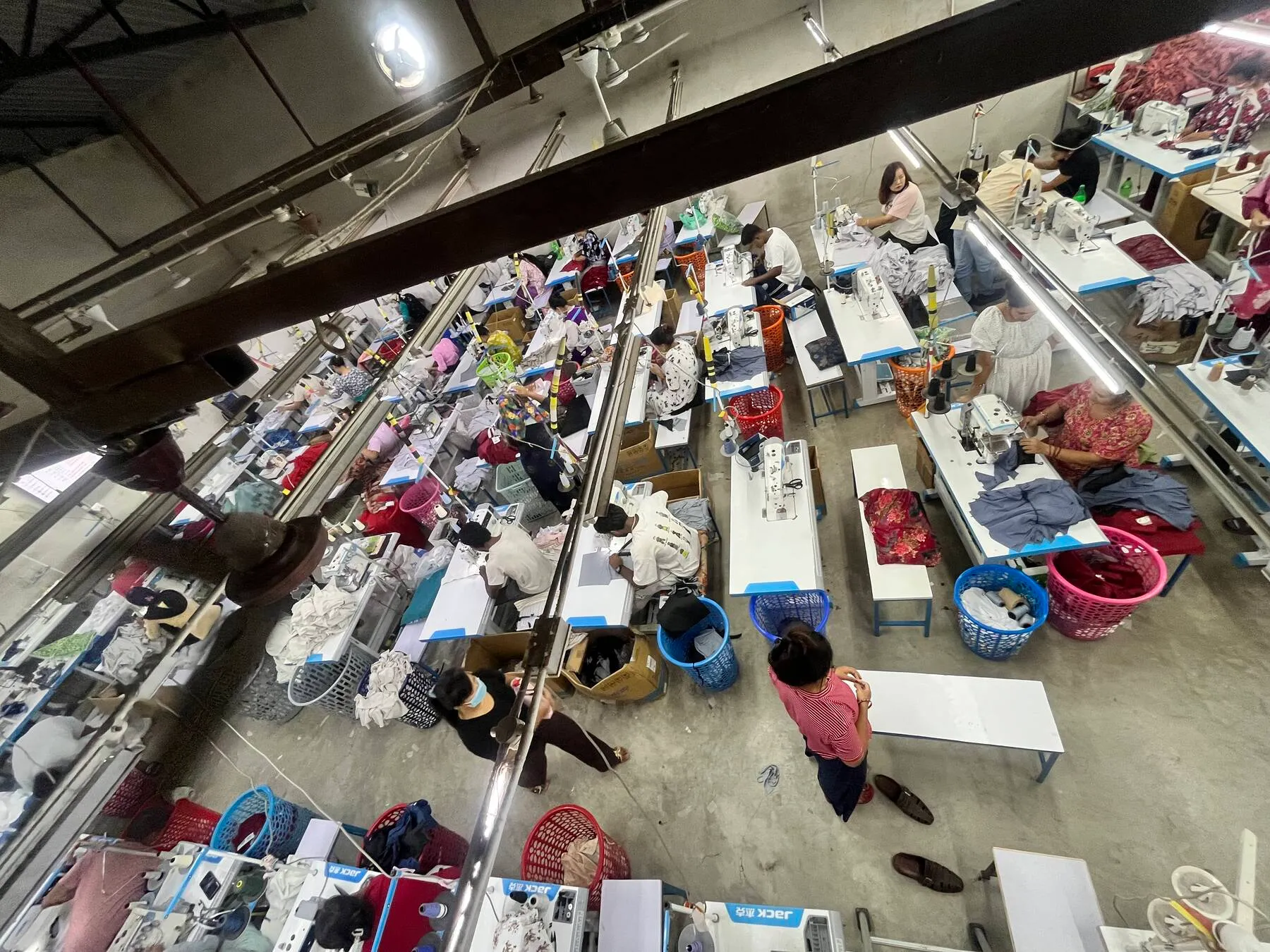
Send us one core style and your current spec, and we will tell you honestly whether we are the right fit.
Frequently asked
Does Chinese fabric stop Nepal-made garments qualifying for 0% duty?
Should I split styles or split volume between my two factories?
How much volume can a Nepali second source take?
Is Nepal duty-free into the United States?
What happens to Nepal’s duty-free access after LDC graduation?
About the author
Santosh Rijal runs Trishakti Apparel, the export knitwear factory his family built on three decades in Nepal’s fashion trade. He writes about sourcing, duty and production from the factory floor in Gaindakot.
LinkedIn ↗