How to · Quality
How are T-shirts made? The process, step by step, from a factory floor
How a T-shirt goes from yarn and fabric to a packed carton: knitting and dyeing at the mill, then pattern, cutting, sewing, inspection and packing at the factory, explained by a cut-and-sew factory in Nepal.
A T-shirt is made in two stages, usually at two different businesses. A mill turns fibre into yarn and knits it into fabric, then the fabric is dyed and finished. A cut-and-sew factory then patterns it, cuts it and sews it into shirts. We are the second kind: we cut and sew in Gaindakot, Nepal, from fabric knitted to the buyer’s spec. Here is the whole journey.
How are T-shirts made, in short?
T-shirts are made by spinning fibre into yarn, knitting the yarn into fabric, then dyeing and finishing it. A factory makes a pattern, cuts the fabric into panels and sews the panels together, adding the neck rib, sleeves and hems. Each batch is then inspected, labelled, folded and packed for shipping.
| Stage | Where it happens | What can go wrong |
|---|---|---|
| Yarn and knitting | Mill | Wrong count or yarn type, uneven fabric |
| Dyeing and finishing | Mill or dye house | Shade differences between lots, shrinkage |
| Pattern and marker | Factory | Poor fit, wasted fabric |
| Cutting | Factory | Panels off-grain, which can add to twisting |
| Sewing | Factory | Wavy necklines, uneven seams |
| Inspection and packing | Factory | Defects missed, wrong size ratio in cartons |
How is T-shirt fabric made?
Most T-shirt fabric starts as cotton, polyester or a blend spun into yarn. The yarn is knitted on circular machines into single jersey, which comes off as a tube or an opened width. It is then dyed and finished, and often compacted to limit shrinkage. Fabric weight is agreed as GSM.
Those choices decide most of how the shirt feels. Combed or carded yarn changes the surface, GSM changes the weight and drape, and compacting controls shrinkage.
How is a T-shirt pattern made?
A pattern is the set of flat shapes for the front, back, sleeves and neck rib, graded across every size. Our team drafts and grades patterns on Optitex CAD, then builds a marker: the layout of those shapes on the fabric, arranged to waste as little as possible. A sample is sewn and checked for fit before any bulk fabric is cut.
Nothing goes to bulk at our factory until the buyer approves the pre-production sample. Samples take 7–14 days after we review the tech pack.
How is the fabric cut?
The fabric is laid in layers on a cutting table, with the marker on top, and the stacked layers are cut into panels. Panels are then sorted into bundles by size and colour. At our factory, each bundle gets a QR ticket, and it is scanned through every operation until packing, so piece counts can be checked at each stage.
Knit fabric relaxes after it is unrolled, so it is normally left to rest before cutting. Cutting off-grain can add to the twisted side seams known as spirality.
How is a T-shirt sewn?
Main seams are normally overlocked, because that stitch stretches with the knit, and hems are usually coverstitched. Our sewing floor in Gaindakot is a dedicated knit floor of 150+ JACK machines, with checks during sewing as well as at the end.
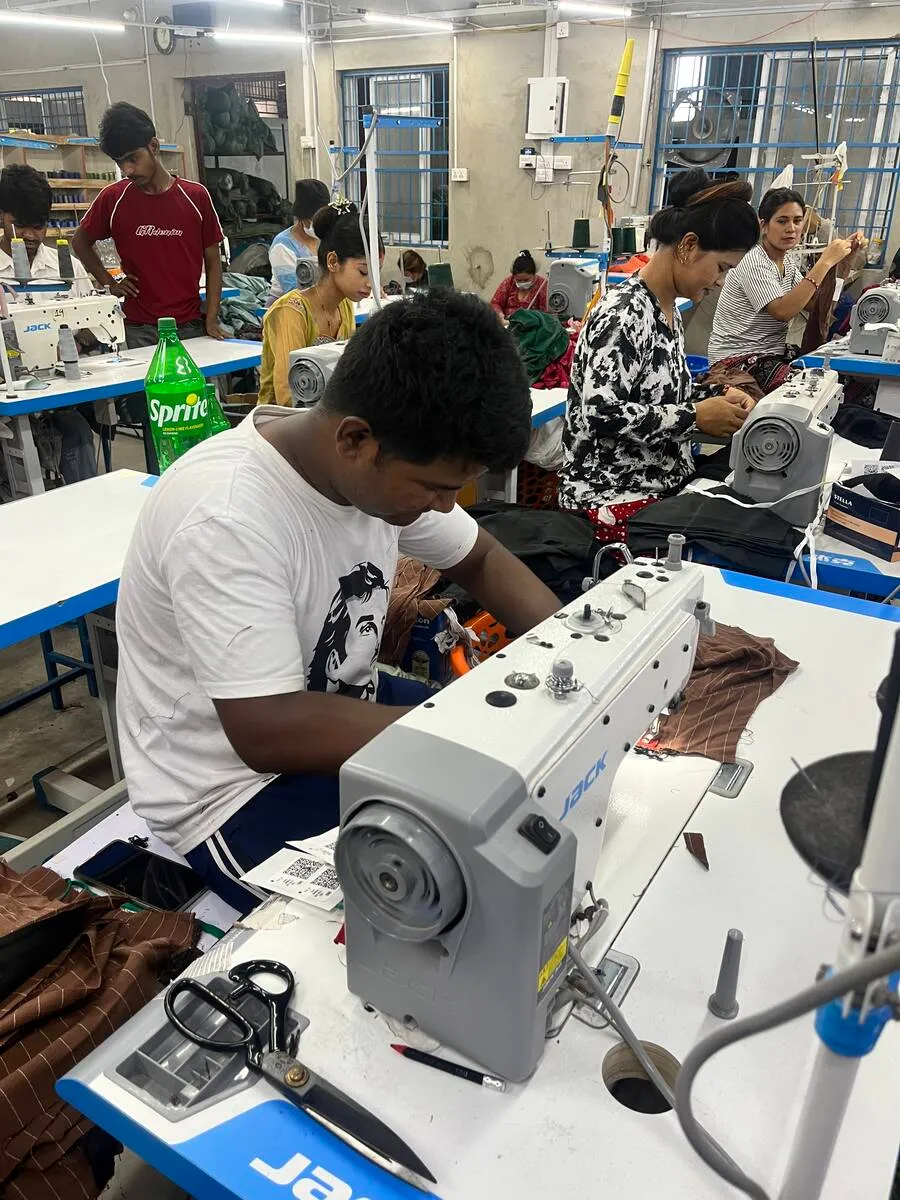
A T-shirt is usually sewn in this order, though factories vary:
- Join the shoulders, often with a tape to stop them stretching.
- Attach the neck rib, then the neck tape and any back-neck label.
- Set the sleeves into the body.
- Close the side seams and sleeves in one continuous seam.
- Hem the sleeves and the bottom.
How are T-shirts inspected and packed?
Finished shirts are trimmed, labelled, pressed or folded, and inspected against the approved sample. We run in-line checks, then a final inspection to AQL 2.5, or the level the buyer sets, and third-party inspectors are welcome. Shirts are then folded, ratio-packed by size and packed in marked cartons with export documents.
What AQL 2.5 means explains how a sample of a batch decides whether it passes. Your woven labels, care labels and hangtags go on at this stage if they aren’t already sewn in, and printing or embroidery is added before or during sewing, depending on the design. We arrange those through partner decorators near Gaindakot.
Where can you see this done?
You can watch our factory film on the About page, ask for a live video walkthrough, or visit us in Gaindakot. If you are working out whether to have your own T-shirts made, start with what cut and sew means and how minimums work.
Frequently asked
How long does it take to make a T-shirt order?
What machines are used to make T-shirts?
Are T-shirts knitted or woven?
About the author
Santosh Rijal runs Trishakti Apparel, the export knitwear factory his family built on three decades in Nepal’s fashion trade. He writes about sourcing, duty and production from the factory floor in Gaindakot.
LinkedIn ↗